

Blog, Designer Dupe Reviews
How to Choose the Best Perfume Dupes That Actually Last: A Complete 2026 USA Guide by Supply Chain Experts
May
Executive Summary
The fragrance industry in the USA is undergoing a massive transformation in 2026. Everyday consumers are increasingly refusing to pay hundreds of dollars for a designer logo when the actual liquid inside the bottle—the “juice”—costs only a fraction of the retail price. However, as the online market floods with cheap alternatives, a new problem has emerged: How do you separate the high-quality, long-lasting perfume dupes from the watered-down, synthetic-smelling knockoffs?
This comprehensive guide is written not by marketers, but from the perspective of fragrance supply chain experts. We will strip away the luxury branding and explain the industry in simple, everyday terms. You will learn how modern perfumes are reverse-engineered, why the “dry-down” is the only test that matters, how the vital aging process (maceration) works, and how to read an ingredients label like a pro.
To give you a completely fair and transparent view of the market, we will evaluate various top players—from accessible giants like Zara and Dossier to Middle Eastern powerhouses like Lattafa, while introducing the factory-direct approach of Imixx. By the end of this article, you will have the exact knowledge needed to build a luxury fragrance wardrobe on a smart budget.
1. The Illusion of Price: Deconstructing the Cost of Luxury Fragrances
To truly understand what makes a good perfume dupe, we first need to look behind the curtain of traditional luxury perfumery. When you walk into a high-end department store in New York or Los Angeles and spend $300 on a 50ml bottle of designer fragrance, what exactly are you paying for?
As professionals who navigate the global supply chain of raw aromatic materials, we can tell you that the cost is rarely in the liquid itself. Here is a realistic breakdown of where your money goes in the traditional luxury model:
- Marketing and Celebrity Endorsements (30-40%): When a brand hires a Hollywood A-lister for a global commercial, prints massive billboard ads across the USA, and buys out magazine spreads, the consumer absorbs that cost.
- Retail Markup and Distribution (40-50%): Traditional department stores and boutiques require massive margins to cover their rent, staff, and overhead. A fragrance sold wholesale for $50 might retail for $150 just to keep the store profitable.
- Packaging, Bottles, and Caps (10-15%): Custom-molded crystal bottles, weighted magnetic caps, and intricate, multi-layered unboxing experiences are incredibly expensive to manufacture and ship.
- The Fragrance “Juice” (2-5%): The actual raw materials—the essential oils, aroma chemicals, and perfumer’s alcohol—often make up the smallest fraction of the total cost.
This economic reality is the foundation of the “inspired-by” fragrance market. If a brand can strip away the celebrity marketing, use elegant but standardized packaging, and sell directly to the consumer online, they can take that $300 experience and offer it for $40 to $60. The challenge for you, the consumer, is finding the brands that actually reinvest those savings into high-quality ingredients, rather than just pocketing the difference.
2. The Science of Scent Replication Made Simple
A common misconception is that perfume dupes are made by someone sitting in a room, sniffing a designer bottle, and guessing the ingredients. In 2026, creating the best perfume dupes is a highly precise science that relies on advanced technology.
Gas Chromatography-Mass Spectrometry (GC-MS) Explained
The secret weapon of modern perfumery is a machine called a Gas Chromatograph-Mass Spectrometer (GC-MS). Think of this machine as a highly advanced barcode scanner for liquids. According to educational resources like the American Chemical Society, mass spectrometry allows chemists to analyze the exact molecular weight and structure of chemical compounds.
When a laboratory analyzes a famous luxury fragrance, the GC-MS machine breaks down the liquid and produces a chart (a chromatogram). This chart reveals exactly how much of a specific molecule—like Linalool (which smells floral/spicy), Iso E Super (which smells velvety and woody), or Vanillin (sweet)—is present in the formula. It effectively hands the chemist a nearly perfect recipe of the original scent.
The Human Element: The Master Perfumer
If machines can give us the recipe, why do some dupes smell terrible? The answer lies in the limitations of technology. A machine can tell a chemist that there is 2% Jasmine extract in the formula, but it cannot easily tell them which Jasmine was used. Was it cheap synthetic Jasmine, or was it pure, expensive Jasmine Sambac harvested in India?
This is where the expertise of the perfumer comes in. A high-quality dupe brand will use the GC-MS data as a starting point, but then rely on an experienced human nose to source the absolute best raw materials to match the depth, warmth, and evolution of the original designer scent. Furthermore, reputable brands ensure that their formulations adhere strictly to the safety and allergy guidelines set by the International Fragrance Association (IFRA), guaranteeing the product is safe for daily skin contact.
3. The Secret Factory Step: Maturation and Maceration
Have you ever bought a cheap fragrance, sprayed it, and immediately recoiled from a harsh, burning smell of rubbing alcohol? Or perhaps you bought a perfume online, felt disappointed that it smelled weak on the first day, but noticed it smelled incredibly rich and smooth a month later? You have experienced the effects of maceration.
In the fragrance supply chain, creating a perfume is much like making a fine wine or a hearty stew. You cannot simply mix the ingredients and serve them immediately. Maceration is the process of allowing the essential oils, aroma chemicals, water, and alcohol to steep and bind together in a cool, dark environment—often in large stainless steel vats—before the liquid is filtered and bottled.
During maceration, chemical reactions occur. The sharp edges of the alcohol soften, the heavy base notes (like woods, resins, and musks) integrate with the lighter top notes (like citrus and fruits), and the entire composition becomes rounder, fuller, and more complex. This process typically takes anywhere from 4 to 12 weeks.
The problem with cheap dupes: Fast-fashion brands and low-tier clone houses operate on razor-thin margins and need rapid turnover. They often mix the oils and alcohol, bottle it the next day, and ship it to USA warehouses immediately. This results in a volatile, unstable scent that blasts you with alcohol and fades quickly.
When evaluating a brand, look for those that emphasize proper aging. For example, brands focused on factory-direct quality, such as Imixx, build necessary maturation periods into their supply chain. This ensures that when the bottle arrives at your door, the fragrance has stabilized and is ready to deliver a smooth, luxurious experience from the very first spray.
4. Perfume Concentrations Demystified: EDP vs. EDT
Another crucial factor in choosing the best perfume dupes is understanding the concentration of perfume oils. Fragrances are a mixture of concentrated fragrance oils and a carrier (usually perfumer’s alcohol). The ratio of oil to alcohol dictates how long the scent will last on your skin, and how strongly it will project into the air around you.
Many consumers are tricked by cheap dupes because the bottle looks identical to a designer brand, but the concentration is vastly lower. Let’s break down the industry standards in the comparative table below.
| Fragrance Concentration Tier | Percentage of Perfume Oil | Average Longevity on Skin | Characteristics & Best Use Case |
|---|---|---|---|
| Eau de Cologne (EDC) | 2% – 5% | 1 – 2 Hours | High alcohol content. Very light, airy, and refreshing. Best for a quick post-shower splash or extremely hot summer days. Fades rapidly. |
| Eau de Toilette (EDT) | 5% – 15% | 3 – 5 Hours | The most common concentration for designer men’s fragrances. Projects well initially but evaporates by midday. Good for office wear. |
| Eau de Parfum (EDP) | 15% – 20% | 6 – 8+ Hours | The gold standard for luxury dupes. Less alcohol means a smoother opening. Excellent balance of projection and all-day longevity. Best for signature scents. |
| Extrait de Parfum (Perfume Extract) | 20% – 40% | 10 – 24+ Hours | The highest concentration. Sits closer to the skin but lasts through showers. Rich, dense, and oily. Best for winter, evening wear, or extreme longevity. |
When searching for the best designer-inspired fragrances, always check the label. If a brand does not explicitly state the concentration (hiding behind vague terms like “fragrance spray” or “body mist”), proceed with caution. Premium alternatives strive for Eau de Parfum (EDP) or Extrait de Parfum concentrations to ensure the scent lasts throughout your workday.
5. Evaluating the US Market: A Fair Look at Top Perfume Dupe Brands
To provide a truly useful guide, it is essential to look at the broader landscape of the US fragrance market in 2026. Different brands serve different purposes, and recognizing their strengths will help you make the best purchasing decision.
Fast Fashion Convenience: Zara
Brands like Zara (often in collaboration with noted perfumers, such as their work with Jo Malone CBE) offer incredible accessibility. You can walk into any mall in the USA and pick up a bottle for under $30. Pros: Extremely affordable, trendy scent profiles, accessible. Cons: Most are formulated at Eau de Toilette (EDT) concentration or lower, meaning you will likely need to reapply them every 3 hours. They are great for a quick fix, but rarely serve as all-day performers.
The Mass-Market Minimalists: Dossier & Alt Fragrances
Brands like Dossier have popularized the dupe movement with heavy social media marketing and clean, minimalist packaging. Pros: Very wide selection, easy-to-understand website, decent everyday wearability. Cons: Due to massive scaling, some fragrance enthusiasts note that certain complex scents can feel slightly flat or linear in the dry-down compared to the niche originals.
The Middle Eastern Powerhouses: Lattafa, Afnan, & Maison Alhambra
The Middle Eastern market has exploded in the USA, offering clones of Western designer scents housed in incredibly elaborate bottles. Pros: Unbeatable longevity; they often use heavy synthetic ouds and musks that last for days. The presentation is unmatched for the price. Cons: The scents can sometimes be overwhelmingly strong or “harsh” upon the first spray due to aggressive formulations, and they often require significant at-home maceration before they become smooth.
The Factory-Direct Precision Approach: Imixx
This is where our supply chain philosophy enters the picture. Imixx was built on the premise of factory-direct transparency. Rather than spending heavily on influencer marketing, the focus is placed entirely on the quality of the aroma chemicals and natural absolutes. Pros: Formulated strictly at high EDP or Extrait concentrations for massive longevity; rigorous adherence to maturation processes before shipping; exact GC-MS matching focusing heavily on the complex base notes. Cons: A more curated, specialized catalog compared to mass-market giants; simpler packaging to keep costs strictly tied to the liquid.
If your goal is to find a fragrance that smells 95% identical to a $350 niche perfume and lasts for 10 hours, seeking out transparent, formulation-focused brands like Imixx or similar boutique houses is the smartest consumer choice.
6. The Ultimate Buyer’s Checklist: Red Flags and Green Flags
Shopping for fragrances online without smelling them first (blind buying) can be intimidating. Use this expert checklist to evaluate any dupe brand before you enter your credit card information.
| Criteria | Green Flags (Signs of Quality) | Red Flags (Signs of a Cheap Knockoff) |
|---|---|---|
| The Dry-Down Test | The brand discusses base notes (woods, vanilla, musk). The scent continues to evolve beautifully 4-6 hours after spraying. | Reviews complain that the scent vanishes after 45 minutes or leaves a sour, metallic, or “chemical” residue on the skin. |
| Ingredient Transparency | Clearly states oil concentration (e.g., 20% EDP) and mentions safety compliances like IFRA. | No mention of concentration; uses generic terms; lacks an ingredients list on the packaging. |
| Alcohol Quality | Uses high-grade perfumer’s alcohol. The initial spray is smooth and immediately releases the top notes. | The first 30 seconds smell overwhelmingly like hand sanitizer or harsh industrial ethanol. |
| Ethical Standards | Explicitly states Cruelty-Free and Vegan formulations, which is standard for high-quality synthetics. | No clear policy on animal testing or the sourcing of raw materials. |
| Packaging Integrity | Uses thick, protective glass bottles and high-quality atomizers that create a fine, even mist. | Flimsy plastic bottles, leaky sprayers, or cheap caps that expose the delicate oils to oxygen. |
7. Deep Dive: Why Some Scents Are Harder to Replicate Than Others
Not all perfumes are equally easy to duplicate. Understanding the complexity of certain scent profiles will help you set realistic expectations.
The Baccarat Rouge 540 Phenomenon
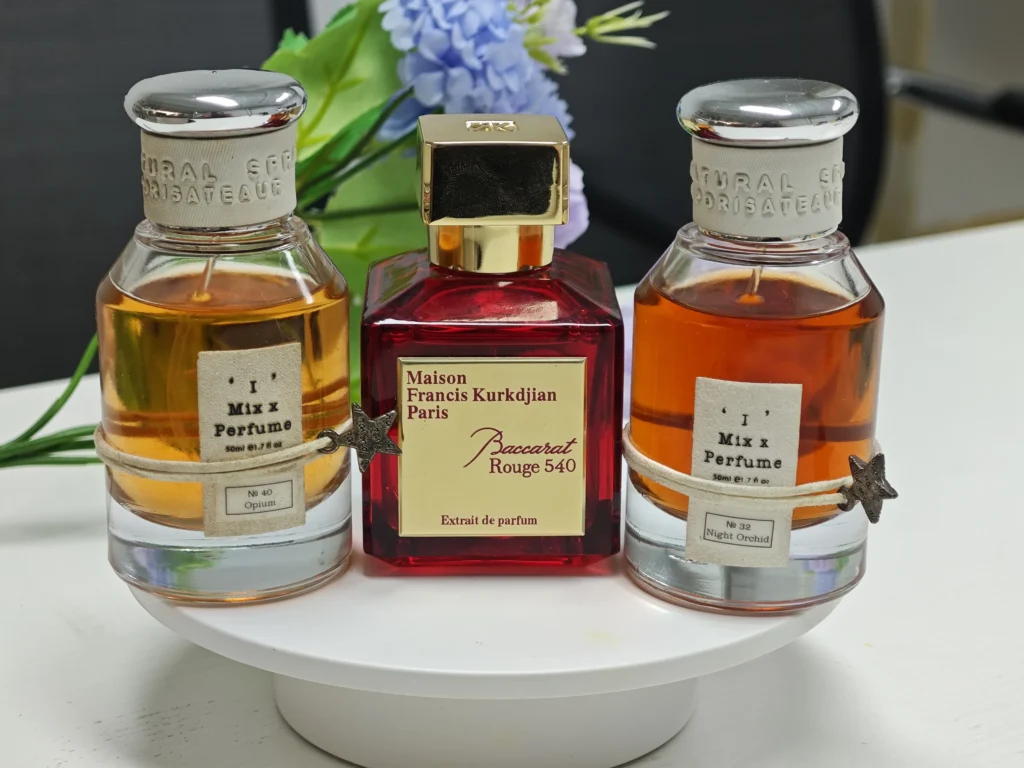
Maison Francis Kurkdjian’s Baccarat Rouge 540 is arguably the most duped fragrance in history. What makes it unique is that it contains almost no natural ingredients. It is a masterpiece of synthetic chemistry, relying on an overdose of Ambroxan (providing a warm, ambery, woody projection) and Ethyl Maltol (providing the burnt sugar/cotton candy sweetness). Because these molecules are commercially available, high-quality dupe houses can recreate this scent with shocking accuracy. A premium Baccarat dupe should retain that strange, “airy” quality where the scent seems to disappear and reappear throughout the day.
The Challenge of Oud and Natural Woods (e.g., Tom Ford Oud Wood)
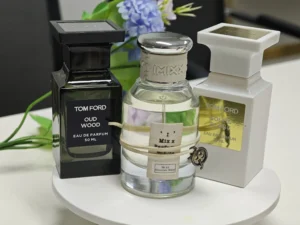
Conversely, fragrances that rely on rare, natural ingredients are notoriously difficult to replicate cheaply. True natural Agarwood (Oud) can cost more than gold per ounce. When a cheap clone house tries to replicate Tom Ford’s Oud Wood, they often use low-grade synthetic oud bases that smell medicinal, rubbery, or like a barnyard. To successfully dupe these profiles, a brand must invest in very high-quality synthetic wood replacers (like Clearwood) and balance them perfectly with spices. This is where the skill of the perfumer, rather than just the GC-MS machine, becomes obvious.
8. Pro Tips: How to Make Your Perfume Dupes Last All Day
Even if you purchase a high-quality Extrait de Parfum from a premium brand, it will underperform if you apply it incorrectly. How you wear your fragrance is just as important as what is inside the bottle. Here is how to maximize your scent trail (sillage) and longevity.
1. Hydration is Key: The Lotion Barrier
Perfume oils need a medium to cling to. If you apply fragrance to dry, ashy skin, the alcohol will evaporate rapidly, taking the precious fragrance oils into the air with it. To lock the scent down, apply an unscented body lotion, a specialized body oil, or a thin layer of petroleum jelly (like Vaseline) to your pulse points before you spray. The lipid barrier grabs onto the perfume molecules, easily doubling the longevity of the scent.
2. Target the Heat (Pulse Points)
Your body heat activates the perfume. Target areas where the veins run close to the skin:
- Inner Wrists: The classic application point.
- Base of the Throat / Behind the Ears: This creates a “scent bubble” that wafts up to your nose and those talking to you.
- Inner Elbows: A fantastic heat generator that holds scent much longer than the wrists.
- Behind the Knees: The ultimate summer trick. As you walk, the heat from your legs pushes the fragrance upward, creating a beautiful scent trail behind you.
3. The “No Rub” Rule
This is the most common mistake consumers make. When you spray perfume on your wrists and aggressively rub them together, the friction generates heat. This heat literally crushes the delicate molecular structure of the top notes (like citrus or light florals), causing the fragrance to skip straight to the dry-down and fade much faster. Spray, and simply let it air dry.
4. Fabric Spraying (With Caution)
While human skin chemistry brings out the unique, intimate nuances of a fragrance, fabric is porous and holds onto scent indefinitely. Spraying a mist onto your sweater or scarf can make the scent last for days. However, always test this on a hidden area first, as the high concentration of oils in premium EDPs can stain delicate fabrics like silk or white cotton.
9. Frequently Asked Questions (FAQ) About Perfume Dupes
We have gathered the most common, highly searched questions from USA consumers regarding designer-inspired fragrances. Here are the objective, industry-backed answers.
About the Author: Linus Dacke Thall
Chief Fragrance Supply Chain Director & Industry Analyst
With over 12 years of hands-on experience in industrial fragrance compounding, raw material procurement, and global cosmetics supply chain logistics, Linus specializes in the analytical chemistry behind scent replication. He is a passionate advocate for consumer transparency in the beauty industry, frequently demystifying how raw materials, maceration processes, and GC-MS technology dictate the true value of a perfume. By cutting through traditional luxury marketing myths, Linus empowers USA consumers to make informed, science-backed decisions about their fragrance wardrobes.
Ready to Experience Factory-Direct Quality?
You now have the insider knowledge to navigate the fragrance market like a professional. Stop paying the “luxury tax” for celebrity marketing and custom glass. Experience the science of perfect scent replication with high-concentration, long-lasting fragrances delivered straight from the formulation lab to your door.
While there are many great options on the market, if you are looking for uncompromising EDP concentrations and meticulous chemical accuracy, we invite you to explore our transparently crafted collection.
