

Best Fragrance Lists, Blog, Designer Dupe Reviews
How to Find the Perfect YSL Black Opium Dupe in the USA: A Master Perfumer’s Guide to Ingredients, Longevity, and Supply Chain Secrets (2026 Edition)
Mar
Executive Summary
The Challenge: The modern USA fragrance market is overflowing with cheap alternatives, body mists, and fast-fashion knockoffs that promise the iconic YSL Black Opium experience. The problem? Most of these “dupes” fade within thirty minutes, leaving behind a harsh, synthetic alcohol smell that lacks depth.
The Objective: To transition away from superficial marketing claims and reveal the underlying chemistry and supply chain mechanics of the perfume industry. As consumers, you deserve to know what you are paying for. We will demystify how luxury fragrances are formulated, why certain dupes fail on longevity, and how to identify high-quality, long-lasting alternatives.
Key Takeaways: You will learn the science of Gas Chromatography (GC-MS), the critical importance of the maceration process, how to decode concentration levels (EDP vs. Extrait), and practical techniques to make your fragrance last longer on the skin. We will also provide an objective, unbiased review of the top alternatives in the US market—including Zara, Dossier, ALT, and our own lab-direct option, Imixx.
By Linus Dacke Thall — Chief Fragrance R&D Director & Supply Chain Specialist
Introduction: The Illusion of the $150 Perfume Bottle
If you are reading this, you are likely captivated by one of the most iconic scent profiles of the 21st century. The intoxicating clash of adrenaline-rich black coffee and sweet, sensual vanilla has made it a staple for evening wear, date nights, and winter months across the USA. It is a masterpiece of modern perfumery, blending the comforting warmth of a gourmand with the edgy mystery of dark florals.
However, the retail price—often exceeding $150 for a standard 3oz bottle at major department stores like Sephora or Macy’s—forces many fragrance enthusiasts into the frustrating, hit-or-miss world of “dupes.”
As a supply chain director and perfumery expert who has spent over a decade sourcing raw materials, auditing factories, and managing fragrance laboratories, I see consumers falling into the trap of deceptive marketing every single day. Brands shout on TikTok and Instagram, “We are the cheapest alternative!” or “Ours is a 1:1 identical match!” without providing a shred of evidence regarding their chemical formulation, safety standards, or aging processes. They rely on the fact that most consumers do not know how perfume is actually made.
The truth is, creating a high-quality YSL Black Opium dupe is not about blindly mixing cheap vanilla extract with artificial coffee flavoring in a bathtub. It is an exact, highly regulated science that requires an understanding of molecular weights, evaporation curves, and global supply chain logistics. Today, we are going to pull back the curtain on the fragrance industry. We will explore how to separate a poorly constructed fast-fashion fragrance from a true lab-grade masterpiece, and we will objectively compare the most popular options available to US buyers right now.
Part 1: The Olfactory Architecture — Deconstructing the Scent Profile
To understand how to find the perfect alternative, we must first understand the structural engineering of the original fragrance. Perfumes are not just a single liquid; they are built in a three-dimensional pyramid structure: Top Notes (the head), Middle Notes (the heart), and Base Notes (the dry down). If a dupe only copies the top notes, you will be deeply disappointed an hour after spraying it.
The Challenge of the Coffee Accord
The defining, addictive characteristic of this iconic fragrance is the “coffee” note. In the commercial perfume industry, extracting natural coffee absolute that remains stable in alcohol is notoriously difficult. Natural coffee extracts tend to turn sour, acrid, or muddy when exposed to oxygen over time. Therefore, master perfumers use a blend of advanced synthetic aroma chemicals (like specific pyrazines) and natural isolates to create a “fantasy coffee accord.”
This is precisely where cheap drugstore dupes fail completely. They use low-grade, generic synthetics that smell like artificial coffee syrup or burnt plastic, rather than the rich, freshly brewed espresso shot intended by the original creators.
The Role of Vanilla and Luminous White Florals
Balancing the dark, bitter coffee is the luminous white floral heart—specifically Jasmine Sambac and Orange Blossom. These florals provide a feminine, narcotic elegance that lifts the heaviness of the coffee. For a deeper dive into how fragrance families interact, the Fragrantica Olfactory Groups guide is an excellent resource for consumers.
The base is anchored by a massive dose of Vanilla, Patchouli, and Cedarwood. The quality of the vanilla is paramount. While true Madagascar Vanilla absolute is incredibly expensive (costing thousands of dollars per kilogram), perfumers often rely on high-quality synthetic molecules like Vanillin or Ethyl Maltol for that cotton-candy sweetness. The precise ratio of these molecules dictates whether the perfume smells like a sophisticated Parisian night out or a cheap, cloying car air freshener.
Table 1: The Chemical Breakdown of the Signature Coffee-Vanilla Scent
| Olfactory Level | Perceived Scent Notes | Scientific Components Often Used | Why Cheap Dupes Fail Here |
|---|---|---|---|
| Top Notes (0-15 mins) |
Pink Pepper, Pear, Orange Blossom | Linalool, Limonene, Pink Peppercorn CO2 Extract | Excessive use of raw, unaged ethanol burns the nose; bright fruit/citrus notes vanish in mere seconds. |
| Heart Notes (15 mins – 4 hours) |
Black Coffee, Jasmine Sambac, Bitter Almond | Pyrazines (for roasted notes), Benzyl Acetate (for Jasmine illusion) | Low-grade Pyrazines smell sharp and metallic instead of warm and rich; jasmine smells like cheap soap. |
| Base Notes (4 – 12+ hours) |
Vanilla, Patchouli, Cashmere Wood, Cedar | Vanillin, Ethyl Maltol, Patchouli Oil, Iso E Super, Ambroxan | Lack of quality chemical fixatives means the fragrance never reaches the base; it simply disappears from the skin entirely. |
Part 2: The Science of Reverse Engineering — Beyond the “Sniff Test”
How do independent laboratories and alternative brands actually recreate these complex designer scents? The answer lies not in a perfumer simply sniffing a bottle and guessing the ingredients, but in empirical analytical chemistry, specifically a process called Gas Chromatography-Mass Spectrometry (GC-MS).
Demystifying GC-MS Technology
Many fragrance brands rely on subjective “blind testing” panels to claim their perfume is a 1:1 match. While human sensory evaluation is crucial for the final polish, it is scientifically flawed as a primary formulation tool. Human noses suffer from olfactory fatigue and subjective bias. What smells like vanilla to you might smell like play-doh to someone else.
In a professional manufacturing facility, we use GC-MS technology. To put it simply, this machine vaporizes a sample of the original fragrance and passes it through a long, coiled microscopic tube. Different molecules travel through this tube at different speeds based on their weight and structure. As they exit, a mass spectrometer reads them, creating a highly detailed “chemical fingerprint” or graph. The American Chemical Society provides fascinating insights into how this technology revolutionized modern chemical analysis.
By analyzing this data, chemists can identify the exact percentage of Linalool, Coumarin, and Vanillin used in the target perfume. However, knowing the recipe is only half the battle. Sourcing the highest-grade raw materials to match that blueprint is what separates a world-class fragrance from a mall kiosk knockoff.
IFRA Compliance and Your Skin’s Safety
A major hidden danger with unverified, hyper-cheap dupes imported from unregulated markets is skin safety. The International Fragrance Association (IFRA) sets rigorous global standards for the safe use of fragrance materials. For example, certain natural extracts (like oakmoss or citrus oils) or synthetic musks can cause severe contact dermatitis, phototoxicity, or allergic reactions if used in concentrations that are too high.
When evaluating a perfume brand in the USA, it is critical to ensure their supply chain adheres strictly to IFRA guidelines. A true expert formulation achieves “beast mode” longevity not by overloading the formula with cheap, restricted chemicals, but by using intelligent, IFRA-compliant base notes and fixatives.
Part 3: The Longevity Crisis — Why Your Fragrance Disappears
The single most common complaint in the USA fragrance community regarding affordable luxury alternatives is longevity. You spray it on, think to yourself, “Wow, this smells amazing!” and then thirty minutes later, it is completely gone. Let’s dissect the supply chain and manufacturing reasons behind this frustrating phenomenon.
1. The Truth About Perfume Oil Concentration
Fragrances are categorized by the ratio of pure, raw perfume oil to the carrier solvent (usually perfumer’s alcohol and a tiny bit of distilled water). The concentration directly impacts how long the scent lasts and how far it projects (sillage).
- Body Mists / Fast Fashion Perfumes: 1% – 5% oil concentration. These contain a massive amount of alcohol, meaning they evaporate almost instantly.
- Eau de Toilette (EDT): 5% – 15% oil concentration. Good for 2-4 hours, typically lighter and more top-note heavy.
- Eau de Parfum (EDP): 15% – 20% oil concentration. The industry standard for luxury designer scents, generally lasting 4-8 hours.
- Extrait de Parfum (Pure Perfume): 20% – 40% oil concentration. The highest tier of perfumery. Extremely rich, sitting closer to the skin but lasting 12 to 24 hours.
Most commercial dupes on the market are legally EDTs or weak EDPs, despite what their marketing boldy claims. To achieve true, all-night performance, you need a brand that is transparent about using higher oil concentrations.
2. The Lost Art of Maceration
Here is a closely guarded supply chain secret that explains why cheap perfumes smell like hand sanitizer: Maceration. Much like a fine wine or a complex stew, perfume needs time to age and marry.
When essential oils, aroma chemicals, and alcohol are first blended in the factory, the mixture is highly volatile. The chemical bonds take time to form and stabilize. Traditional designer brands macerate their fragrances in large stainless steel vats for weeks or even months before filtering and bottling. This rounds off the harsh edges of the alcohol.
Conversely, fast-fashion dupe companies operate on a hyper-fast turnover model to keep costs low. They mix the “juice” on Monday, bottle it on Tuesday, and ship it to a USA warehouse on Wednesday. This complete lack of maceration is exactly why cheap perfumes smell overwhelmingly of sharp rubbing alcohol upon the first spray.
Part 4: Supply Chain Transparency — Why Do Designer Scents Cost $150+?
If the liquid inside the bottle is not inherently worth hundreds of dollars, what are you actually paying for when you buy a luxury fragrance at a high-end department store? The reality of the beauty supply chain might shock you.
As detailed by various business publications covering the economics of the beauty industry, the traditional luxury fragrance business model is highly inefficient and heavily marked up. When you purchase a $150 designer bottle, roughly 80% to 90% of your money goes toward factors that have absolutely nothing to do with the smell:
- Celebrity Endorsements: Millions of dollars are paid to A-list actors, models, and musicians for global ad campaigns and billboard space.
- Retail Markups: Brick-and-mortar stores (like Sephora, Ulta, or Macy’s) take a massive percentage of the retail price (often 40-50%) just to cover shelf space, staffing, and store overhead.
- Licensing Fees: Many famous fashion houses do not actually formulate their own perfumes; they license their brand name to massive beauty conglomerates, adding another layer of corporate profit margin.
- Heavy Glass & Elaborate Packaging: Complex bottle designs, magnetic caps, and luxury boxes add significant manufacturing weight and international shipping costs.
Table 2: Traditional Retail vs. Direct-to-Consumer Model (Industry Averages)
| Cost Category | Traditional Luxury Brand ($150 Bottle) | Lab-Direct DTC Brand ($35 – $50 Bottle) |
|---|---|---|
| The “Juice” (Raw Ingredients & Formulation) | $5.00 – $8.00 | $8.00 – $12.00 (Often higher oil concentration due to budget reallocation) |
| Bottle, Cap & Packaging | $10.00 – $15.00 | $3.00 – $5.00 (Minimalist, standardized, eco-friendly) |
| Marketing, Billboards & Celebrity Ads | $40.00+ | $2.00 – $5.00 (Digital marketing, SEO, word of mouth) |
| Retailer Margin / Distributor Markup | $60.00+ | $0.00 (Shipped directly from warehouse to USA consumer) |
| Brand Royalty / Licensing | $20.00+ | $0.00 (In-house brand ownership) |
Note: The above figures are generalized industry estimates intended to illustrate standard markup structures in the cosmetics sector.
Part 5: The Top YSL Black Opium Dupes in the USA Market — An Objective Review
As a supply chain professional, I believe in transparency. There is no single “perfect” option for every consumer; it depends on your budget, whether you prefer shopping in-store or online, and how much you value longevity versus pure cost savings. Here is a fair, objective breakdown of the most popular alternatives currently trending in the USA.
1. Zara – Gardenia
Zara has become a behemoth in the affordable fragrance space. Gardenia is frequently touted on social media as the ultimate cheap alternative.
- The Pros: It is incredibly affordable (often under $25 for a large bottle) and very accessible. You can walk into almost any Zara store in the US and test it before buying.
- The Cons (From a Formulation Standpoint): Zara fragrances are notoriously light. Gardenia leans heavily into the white florals and vanilla, but almost entirely misses the dark, roasted coffee note that gives the original its edge. Furthermore, the oil concentration is quite low, meaning it operates more like an EDT. You will likely need to reapply every 2 hours.
2. Dossier – Ambery Vanilla
Dossier is a major player in the direct-to-consumer dupe market, famous for their minimalist packaging and vegan formulas.
- The Pros: They offer a very solid, recognizable interpretation of the scent profile. The opening is bright, and the dry down is pleasantly sweet. They also offer a fantastic return policy, which lowers the risk of blind buying online.
- The Cons: While it is a step up from Zara, many users report that the longevity is still “average” (around 4-5 hours). It lacks the deep, dense projection that some fragrance lovers desire for a night out, functioning more as a safe, everyday office-friendly version of the scent.
3. ALT Fragrances – Fleur Noire
ALT focuses heavily on recreating designer scents with a slightly more robust oil concentration than fast-fashion brands.
- The Pros: Fleur Noire projects quite strongly in the first hour. It captures the coffee and pink pepper clash reasonably well, making it a bold choice for evening wear.
- The Cons: Because they push for high projection, the opening can sometimes come across as slightly harsh or overly synthetic to sensitive noses, taking about 20 minutes to settle down into a smooth vanilla.
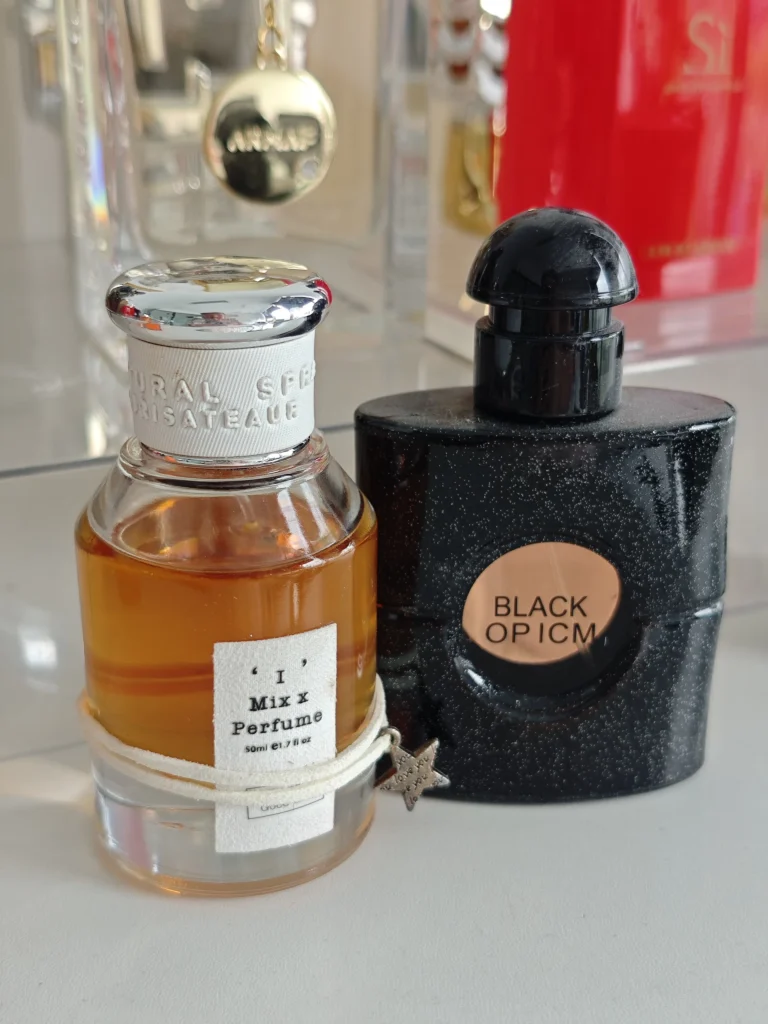
4. Imixx – No. 40 YSL Black Opiume Dupe
Full disclosure: This is our formulation at Imixx. We engineered this specifically to address the pain points of longevity and maceration found in the options above.
- The Pros: We utilize an Extrait-level concentration. By reallocating the budget usually spent on marketing into the raw juice, Imixx No. 40 delivers exceptional longevity. More importantly, we enforce a strict factory maceration period. This means the alcohol is fully integrated before it reaches you, resulting in a smooth, rich, and deeply complex coffee-vanilla aroma from the very first spray.
- The Cons: As a direct-to-consumer lab brand, we do not have physical retail storefronts in the USA. You cannot test it in person before purchasing, which does require a leap of faith for first-time buyers relying on online reviews.
Part 6: Expert Tips: How to Maximize Fragrance Longevity
Even with a high-quality, perfectly macerated Extrait de Parfum, your personal application technique and skin chemistry can drastically alter the longevity and projection of your scent. Here are insider tips from the lab on how to make your perfume last all night long.
1. The Hydration Rule (The Vaseline/Lotion Trick)
Perfume oils evaporate at an accelerated rate on dry skin. In the USA, especially during harsh winters in the Northeast or in arid climates like Arizona and Nevada, dry skin is a major culprit for poor longevity. The solution? Always apply an unscented body lotion or a thin layer of an occlusive ointment like petroleum jelly (Vaseline) to your pulse points before spraying. This creates a lipid barrier on the skin, giving the fragrance oils something physical to bind to, slowing down the evaporation process.
2. Target the Optimal Pulse Points
Heat activates fragrance molecules. Apply your perfume to areas where your veins are closest to the skin’s surface, as these areas emit more body heat: the inner wrists, the base of the throat, behind the ear lobes, the inner elbows, and even behind the knees. The subtle heat will help diffuse the heavier coffee and vanilla notes steadily throughout the evening.
3. Never “Bruise” the Scent
A frustratingly common habit is spraying the wrists and aggressively rubbing them together. This friction creates sudden, localized heat that physically breaks down the delicate, volatile top notes (like the pear and pink pepper), accelerating the evaporation curve and muddling the fragrance’s intended progression. Simply spray the area and let it air dry naturally.
4. Hair and Fabric Application (With Caution)
While your skin’s pH and temperature alter a scent beautifully, fabric and hair retain scent much longer than human skin. Spraying a light mist onto your scarf, the lining of your jacket, or using a dedicated hair mist technique (spraying a brush and running it through your hair) will leave an intoxicating scent trail (sillage) that can last for days. *Caution: Only spray on dark fabrics, as high-concentration oils and vanilla ingredients can lightly stain white clothing.*
Ultimate FAQ: Everything You Need to Know About Coffee-Vanilla Perfumes
Based on the most common questions from our USA consumers and trending Google searches, we have compiled this definitive Q&A to help you navigate your fragrance journey.
1. What is the best affordable luxury alternative for YSL Black Opium?
There are several great options depending on your needs. For pure budget and convenience, Zara Gardenia is popular, though light. For a balanced, everyday vegan option, Dossier’s Ambery Vanilla is solid. However, if your primary concern is longevity and depth, Imixx No. 40 is formulated at an Extrait level to provide a robust, long-lasting coffee-vanilla experience that rivals the original’s performance.
2. What does the original fragrance actually smell like?
It is classified as an Oriental Gourmand. It opens with a bright, slightly spicy flash of pink pepper and pear. Within twenty minutes, it transitions into its signature phase: a dark, slightly bitter espresso note enveloped by sweet, creamy white flowers (jasmine and orange blossom). The dry down is a very heavy, warm, and cozy base of vanilla and patchouli. It is inherently mysterious, highly feminine, and seductive.
3. Why do cheaper clones smell so strongly of rubbing alcohol?
This is a hallmark of a rushed, low-budget supply chain. Cheap clones use a very low percentage of actual perfume oils (often under 5%) and a high percentage of cheap industrial ethanol. Most importantly, they skip the critical “maceration” step—the aging process where the oil and alcohol bond over several weeks. Without maceration, the alcohol hits your nose aggressively before the scent oils can register.
4. Can I layer this type of fragrance with other perfumes?
Absolutely. Fragrance layering is an excellent way to create a bespoke scent and enhance longevity. The sweet coffee-vanilla DNA pairs beautifully with single-note linear fragrances. Try layering it over a pure vanilla body lotion to amplify the gourmand sweetness, or pair it with a dry cedar/sandalwood scent to tone down the sugar and make it more woody and sophisticated.
5. How long should a good quality alternative last on the skin?
A well-formulated Eau de Parfum (EDP) or Extrait de Parfum should give you a solid 6 to 8 hours of noticeable wear on moisturized skin, and up to 12+ hours on clothing. If your current perfume fades to nothing in 1-2 hours, it is likely highly diluted and operating as a body mist.
6. What are the core notes I should look for in a quality dupe?
To capture the true essence, look beyond just “vanilla.” A faithful formula must explicitly feature a dark coffee/roasted accord (look for mentions of pyrazines or espresso), white floral notes (jasmine sambac or orange blossom) for balance, and a grounding woody/patchouli base to prevent it from smelling like overly sweet, linear candy.
7. Is it safe to buy lab-direct or dupe perfumes in the USA?
Yes, provided the brand is transparent about its manufacturing. Always look for brands that explicitly state they use IFRA-compliant ingredients. This ensures the raw materials adhere to strict global safety standards for skin contact, minimizing the risk of allergies. Reputable brands prioritize clean, safe, and ethically sourced formulations.
8. What occasions and seasons are best suited for this scent profile?
Due to its warm, gourmand, and slightly heavy nature, this fragrance profile shines during the cooler autumn and winter months. It is widely considered the ultimate “date night,” evening-out, or clubbing fragrance. However, applying a very light, single spray under your clothes can make it suitable for a cozy daytime office environment.
9. Does perfume expire or go bad?
Yes and no. High-quality fragrances with a proper alcohol carrier act as their own preservative. If stored correctly—in a cool, dark place away from direct sunlight, heat, and humidity (like a dark bedroom drawer, not a steamy bathroom)—a well-macerated perfume can easily last 3 to 5 years. In fact, vanilla-heavy scents often darken in color and become richer and more potent as they age.
10. What is the difference between the original YSL Opium and Black Opium?
Despite sharing a name, they are completely different fragrances from different eras. The original Opium, launched in the 1970s, is a classic, heavy, vintage spicy amber scent loaded with myrrh, cloves, and incense. Black Opium, launched decades later in 2014, is a modern gourmand focused entirely on sweet coffee, vanilla, and white florals. They share a brand heritage, but their olfactory profiles appeal to completely different tastes.
Conclusion: Empowering the Educated Consumer
The landscape of the USA fragrance market is undergoing a massive shift. Consumers are becoming highly educated “fragrance geeks.” They are reading ingredient lists, demanding supply chain transparency, and refusing to pay massive markups for mediocre performance.
You no longer have to accept the inflated costs of traditional luxury retail, nor do you have to settle for poorly constructed, fast-fading imitations from fast-fashion stores. By understanding the chemistry of GC-MS, the vital importance of factory maceration, and the reality of oil concentrations, you are now equipped to make an informed choice that elevates your personal style without draining your wallet.
Whether you choose the accessibility of Zara, the minimalist approach of Dossier, or the lab-direct, high-concentration performance of Imixx
No. 40, the goal is the same: to smell incredible, feel confident, and understand exactly what is in the bottle. We invite you to explore the science of scent further and discover your new signature fragrance at Imixx.net.
