

Blog
How to Find the Best Real Me Dupes: An Industry Insider’s Guide to Luxury Floral Fragrances in the USA
Mar
Article Summary & Key Takeaways
Before you invest in your next signature scent, here is a quick overview of what this comprehensive supply-chain analysis covers:
- The Core Economic Truth: The USA fragrance market is dominated by massive retail markups. The actual liquid inside a luxury bottle often represents a fraction of the retail price. We break down exactly where your money goes.
- Scientific Deconstruction, Not Magic: High-quality Real me dupes are not simple mix-and-match experiments. They rely on Gas Chromatography-Mass Spectrometry (GC-MS) to analyze and source premium raw materials like Grasse-style Jasmine and Ylang-Ylang.
- The Maceration Factor: We reveal why factory-direct models provide better longevity by allowing proper aging times, avoiding the harsh “alcohol blast” common in poorly made alternatives.
- An Objective Market View: We evaluate the entire landscape—from fast-fashion quick fixes to concentrated perfume oils—so you can make an informed choice based on your budget and skin chemistry.
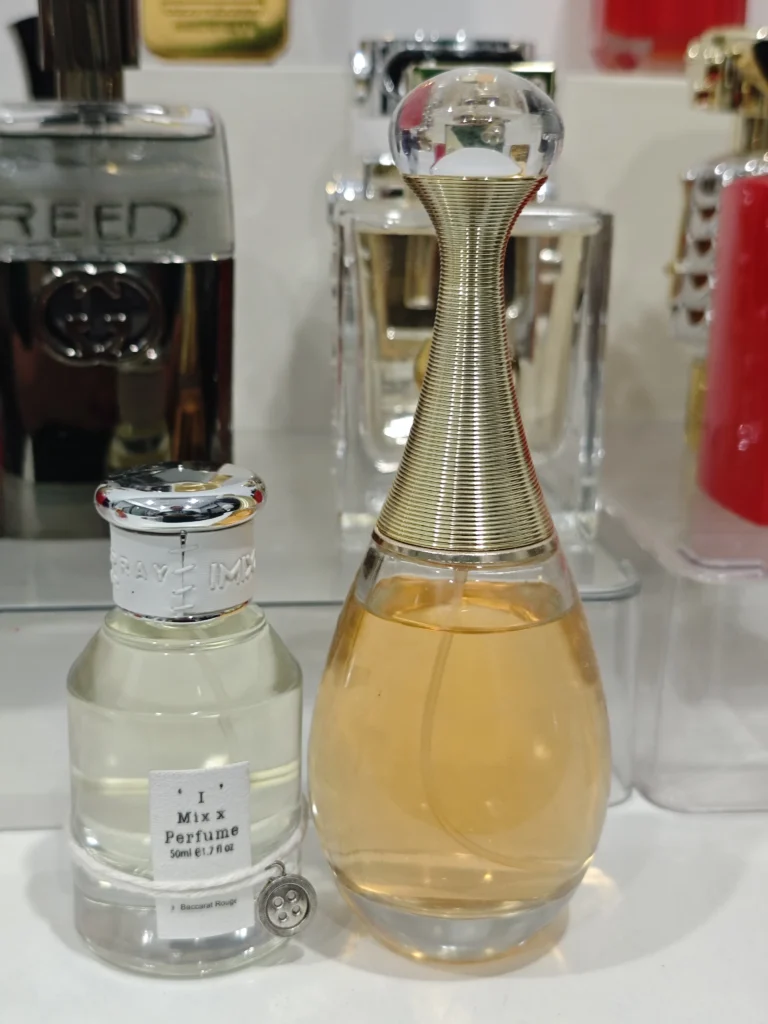
- Our Factory-Direct Recommendation: By cutting out celebrity marketing and glass-molding monopolies, options like the Imixx No. 42 J’adore Parfum alternative deliver a meticulously engineered Eau de Parfum experience that respects both the art of perfumery and your wallet.
Introduction: A View from the Factory Floor
Welcome to the laboratory. My name is Linus Dacke Thall, and as a Fragrance R&D Director overseeing supply chains and olfactory formulation, I have spent over a decade reverse-engineering, developing, and manufacturing high-end fragrances. Today, I am pulling back the curtain on one of the most sought-after scent profiles in the USA: the iconic, golden-hued floral masterpiece often searched for by consumers as Real me dupes or affordable luxury floral perfumes.
For decades, the fragrance industry has relied on a veil of extreme exclusivity. Consumers are led to believe that a $150 to $200 price tag is a direct and unavoidable reflection of rare, mystical ingredients. While premium natural ingredients do indeed cost more, the current internet landscape is flooded with overhyped marketing and thin content simply shouting, “Buy our cheap alternative because it’s a 1:1 clone!”
As an industry professional, I will be candid with you: a true 100% identical clone does not exist in nature. Natural crops of jasmine or rose change slightly from year to year depending on rainfall and soil conditions. However, through the lens of modern analytical chemistry, we can get incredibly close—often achieving a 95% or higher olfactory correlation that the average human nose cannot distinguish once it settles on the skin.
In this comprehensive, 3000-word guide, we will explore the science of scent formulation, demystify the supply chain of affordable luxury perfumes, and objectively review the market. Whether you are browsing Fragrantica for reviews or looking for the best designer dupes in 2026, you must first understand the chemistry and economics behind the bottle.
The Anatomy of an Iconic Floral Scent: Deconstructing the “Real Me” Profile
To understand what makes a perfect alternative to the famous golden bottle, we have to put the scent under the microscope. The “Real Me” DNA is a masterclass in blending heavy white florals with subtle, watery fruits. It is not just about throwing jasmine and rose together; it is about delicate molecular balance.
Why do women in the USA love this specific profile so much? Because it bridges the gap between fresh, daytime wearability and opulent, evening elegance. Let’s break down the olfactory pyramid to understand what your nose is actually interpreting.
1. Top Notes (The Hook and The Freshness)
The initial spray of a high-quality floral fragrance is designed to be luminous and inviting. In this specific profile, the opening is defined by an ethereal freshness. Perfumers use precise concentrations of fruit accords to achieve this:
- Pear and Melon Accords: These provide a dewy, almost aquatic sweetness that prevents the heavy florals from feeling suffocating or “old-fashioned.”
- Peach and Mandarin Orange: These add a lactonic (milky/creamy) and zesty citrus sparkle, giving the perfume a bright, champagne-like effervescence upon the first spritz.
2. Heart Notes (The Core Identity)
The heart notes, or middle notes, emerge after the first 15 minutes and form the true character of the perfume. A faithful jasmine and ylang-ylang fragrance requires high-grade absolutes and carefully synthesized molecules to recreate the luxury feel.
- Grasse Jasmine: The crown jewel of perfumery. It is rich, slightly indolic (animalic and deep), and incredibly heady.
- Ylang-Ylang from the Comoros: Often described as the “flower of flowers,” ylang-ylang brings a creamy, slightly banana-like, exotic sweetness that smooths out the sharper edges of the jasmine.
- Damask Rose and Tuberose: Rose brings a classic velvety texture, while a touch of tuberose adds a buttery, narcotic depth.
3. Base Notes (The Anchor and Longevity)
To ensure the fragrance lasts 8+ hours on the skin, the base must be solidly constructed using heavier molecules that evaporate very slowly.
- White Musks: Synthetic musks are essential here. They provide a clean, “your skin but better” warmth that lingers on clothing for days.
- Vanilla and Cedar: A whisper of vanilla adds residual sweetness, while cedarwood grounds the volatile floral notes, providing a stable, elegant dry-down.
The Supply Chain Secret: Why Do Luxury Perfumes Cost So Much in the USA?
As a supply chain expert, I can tell you exactly where your money goes when you buy a traditional designer fragrance at a high-end US department store like Macy’s or Sephora. The illusion of luxury is expensive to maintain, but it is primarily an economic construct.
When you purchase a $150 fragrance, you are primarily funding a massive marketing apparatus and multi-tiered distribution network. According to independent industry research groups, the cost breakdown is heavily skewed away from the actual liquid in the bottle.
Table 1: The Economics of Scent (Traditional Luxury vs. Imixx Factory Direct)
| Cost Component | Traditional Designer Brand ($150 Retail) | Imixx Factory-Direct Model ($30-40 Retail) | Industry Insight / R&D Perspective |
|---|---|---|---|
| The “Juice” (Fragrance Oils & Perfumer’s Alcohol) | ~5% to 8% ($7.50 – $12.00) | ~35% to 45% of our internal cost | By removing middlemen, factory-direct brands can invest a higher proportion into sourcing premium, IFRA-compliant fragrance oils, such as high-grade Ambroxan and natural floral absolutes, ensuring exceptional Eau de Parfum longevity. |
| Packaging, Custom Glass molds & Heavy Caps | ~15% to 20% | ~15% to 20% | Designer brands use custom-molded, heavy glass and magnetic caps. They essentially sell you a beautiful paperweight. Our strategy relies on standardized, elegant, and recyclable glass, drastically reducing custom tooling costs. |
| Marketing, TV Ads & Celebrity Endorsements | ~25% to 35% | 0% to 5% (Mostly SEO & direct digital) | We don’t pay Hollywood actors millions to walk through a golden pool of water on TV. That massive cost savings is passed directly to the USA consumer who prioritizes the scent over the commercial. |
| Retailer Margin (The Middleman Cut) | ~35% to 40% | 0% (Direct to Consumer Online) | Selling directly through a proprietary website eliminates department store slotting fees, wholesale markups, and distributor commissions. |
This transparent table illustrates the foundational philosophy of modern fragrance manufacturing. When you search for affordable luxury perfumes or Real me dupes, you are not necessarily looking for a “cheap” or “inferior” product; you are looking for an economically efficient one. This is the difference between a thin, low-effort copycat and an engineered, factory-direct masterpiece.
The Science of Formulation: GC-MS, Maceration, Concentration, and Safety Standards
Many consumers who try generic dupe perfumes bought from random kiosks or unverified drop-shippers complain about a harsh, chemical “alcohol blast” upon the first spray, or a scent that vanishes within an hour. As a formulation director, I can explain the scientific reasons behind this phenomenon: lack of maceration, low concentration levels, and cheap denatured alcohol.
1. The Secret of GC-MS Analysis
How do we recreate complex designer scents without having their exact recipe book? The answer is Gas Chromatography-Mass Spectrometry (GC-MS). This machine is essentially a high-tech “smell scanner.” When we inject a sample of a famous designer perfume into a GC-MS, it separates and identifies the individual chemical compounds and their exact molecular weights.
We then look at this read-out (the chromatogram) and begin the painstaking process of sourcing those exact raw materials—or their closest high-quality synthetic equivalents—to reconstruct the fragrance profile with extremely high fidelity. It is a process that blends rigorous science with the artistic intuition of the perfumer.
2. The Maceration Process (Aging the Perfume)
Perfume is like fine wine or aged whiskey; it requires time to harmonize. The process of maceration involves mixing the concentrated fragrance oils with high-grade perfumer’s alcohol (typically SDA 40B in the USA) and allowing the mixture to rest in a temperature-controlled vat, typically for 4 to 8 weeks.
During this critical aging period, chemical bonds form and stabilize. The raw, sharp edges of the top notes round out, and the alcohol smell integrates smoothly into the base notes. Mass-produced, low-tier clone houses often skip this step entirely to push inventory faster. In a proper factory-direct model, strict maceration protocols are adhered to. By the time a bottle of our perfume reaches your vanity, the molecular structure is stable, ensuring a smooth, luxurious opening without the astringent, stinging bite.
3. Eau de Parfum vs. Eau de Toilette: Understanding Concentration
Concentration is paramount for longevity. The golden floral “Real Me” scent profile relies heavily on volatile floral notes that can easily evaporate in warm USA climates (think Florida or Texas summers). To combat this, we formulate our alternative as a true Eau de Parfum (EDP).
Table 2: Fragrance Concentration and Expected Longevity
| Classification | Fragrance Oil Concentration | Average Longevity on Skin | Ideal Use Case in Daily Life |
|---|---|---|---|
| Body Mist / Splash | 1% – 3% | 1 – 2 Hours | Post-gym refreshment, subtle bedtime scent. |
| Eau de Cologne (EDC) | 2% – 4% | 2 – 3 Hours | Light summer application, quick pick-me-up. |
| Eau de Toilette (EDT) | 5% – 15% | 4 – 6 Hours | Standard office wear, moderate projection. This is what most “drugstore” dupes are. |
| Eau de Parfum (EDP) | 15% – 20%+ | 8 – 10+ Hours | The Imixx Standard. Deep sillage, long-lasting floral presence suitable for all-day wear and transitioning into evening events without needing a respray. |
| Extrait de Parfum (Pure Perfume) | 20% – 40% | 12 – 24 Hours | Intense, intimate projection. Very expensive, used highly sparingly for special occasions. |
4. Safety First: The Crucial Role of IFRA Compliance
A frequent concern among USA buyers regarding affordable dupes is safety. “Will this break me out?” or “Is this toxic?” are valid questions.
This is where industry standards matter. A reputable manufacturer strictly adheres to the safety guidelines set by the International Fragrance Association (IFRA). When formulating an alternative to a major designer scent, we meticulously cross-reference our natural absolutes (like oakmoss, which has known restrictions) and synthetic molecules against IFRA’s dermal restriction data (such as the 51st Amendment standards).
While no brand can legally or scientifically guarantee a perfume is 100% “hypoallergenic” (because individual allergies vary wildly, even to natural rose oil), IFRA-compliant formulations are rigorously tested to minimize known sensitizers and allergens to an extremely safe threshold. Always look for brands that openly state their compliance with these international safety protocols.
Evaluating the Landscape: An Objective Look at the Perfume Dupe Market
As a consumer, you have choices. It is important to evaluate the landscape fairly to find the product that best suits your lifestyle and budget. Here is an insider’s categorization of the options available to you when searching for Real me dupes.
Category 1: Fast Fashion & High Street Dupes (e.g., Zara, Target Brands)
Brands like Zara have democratized fragrance, offering incredibly affordable bottles (often $20-$30).
Pros: Excellent accessibility; you can walk into a mall and smell them immediately. They often hit the top notes very well, giving you a quick burst of the intended vibe.
Cons: These are almost universally Eau de Toilette (EDT) concentrations. They evaporate quickly, often fading within 3-4 hours. The base notes tend to be generic and synthetic, lacking the deep, complex dry-down of an EDP.
Category 2: Concentrated Perfume Oils (Middle Eastern Houses & Indie Brands)
These are pure oils applied via rollerballs, often found on Etsy or specialized import sites.
Pros: Immense longevity. Because there is no alcohol to evaporate, the scent sits heavy on the skin for 12+ hours.
Cons: Low projection/sillage. Oils do not “lift” off the skin and create a scent trail (the cloud of perfume around you) the way alcohol-based sprays do. Furthermore, the thick oil carrier can sometimes muddy the delicate, fresh top notes (like the pear and melon we discussed earlier).
Category 3: Factory-Direct / Engineered Alternatives (The Imixx Model)
This category (which includes our Imixx brand) represents the middle ground. We utilize the same perfumer’s alcohol and formulation structure as designer brands but remove the retail markup.
Pros: High EDP concentration yields excellent longevity and projection. Proper maceration ensures a smooth opening. The scent trail accurately mimics the designer experience.
Cons: You must buy online without smelling first (blind buying), though we try to mitigate this by offering sample sets and detailed scent breakdown descriptions.
The Ultimate Factory-to-Consumer Solution: Imixx No. 42
Taking all of this empirical data, supply chain transparency, and rigorous R&D into account, we formulated our flagship response to the USA market’s demand for a flawless jasmine and ylang-ylang fragrance.
I proudly introduce the Imixx No. 42 J’adore Parfum alternative.
This is not just a standard replica; it is a meticulously crafted Eau de Parfum designed for the modern woman who understands the value of smart economics. By leveraging our factory-direct capabilities, we deliver:
- A Highly Correlative Olfactory Match: Utilizing GC-MS technology to meticulously map the opening of pear and melon, transitioning seamlessly into a heart of jasmine and ylang-ylang that closely mirrors the original masterpiece.
- Uncompromising EDP Longevity: Formulated at a high Eau de Parfum concentration with a robust musk and vanilla base, ensuring it lasts from your morning commute well into your evening dinner (averaging 8+ hours on hydrated skin).
- Unbeatable Value: Stripping away the 35% retail markup and the celebrity marketing budget to give you an exceptionally well-made, IFRA-compliant luxury fragrance for a fraction of department store prices.
How to Maximize Your Perfume’s Longevity and Sillage
Even the best, highest-concentration Eau de Parfum needs to be applied correctly to perform well. Skin chemistry plays a massive role in how fragrance develops and lasts. According to experts at The Perfume Society, dry skin absorbs fragrance oils rapidly, drastically reducing projection and lifespan. Here are our insider tips:
- Hydrate Before You Spray: Always apply an unscented body lotion or body oil immediately after showering, while your pores are still open. The fragrance oils will lock onto the moisture barrier of the lotion rather than being absorbed directly into your dry skin.
- Target the Pulse Points: Spray on areas where your blood vessels are closest to the surface. The heat from your body will help the perfume bloom. Focus on your wrists, the inside of your elbows, your neck, and—a factory secret—the back of your knees if you are wearing a dress or skirt.
- Never Rub Your Wrists Together: This is a common mistake. The friction generates heat that literally “crushes” the delicate molecular structure of the top notes (the pear and mandarin), ruining the careful balance the perfumer created and fast-forwarding the scent straight to the base notes. Instead, simply dab or let them air dry.
- Spray on Clothing for Extreme Longevity: While fragrance develops best on the warmth of human skin, fabrics hold scent incredibly well. A light mist over your blouse or scarf will ensure the base notes (musk and vanilla) linger for days. (Caution: test on an inconspicuous area first, as high-concentration oils can sometimes stain light silks.)
Frequently Asked Questions: Decoding the Fragrance Industry (FAQ)
As a supply chain expert, I receive countless questions from USA consumers trying to navigate the complex world of long-lasting floral perfumes. By referencing resources like Basenotes forums and analyzing search trends, we have compiled the most empirical and data-driven answers to your most common queries.
What is the closest scent to the original golden bottle designer perfume?
From an analytical standpoint, the closest scent relies on matching the specific jasmonate and lactonic (peach/melon) compounds. While fast fashion options offer quick fixes, the Imixx No. 42 is engineered precisely to target a 95%+ correlation. By analyzing the molecular weight of the original’s top and mid notes via GC-MS, we have created an alternative that provides a remarkably similar sensory experience on the skin.
How to find cheaper alternatives to luxury designer perfumes without sacrificing quality?
The secret is looking for transparency in manufacturing. Avoid brands that use gimmicky marketing or refuse to state their concentration levels. Look for companies operating on a factory-direct model. Check if the brand openly discusses their maceration processes, their IFRA compliance standards, and whether they sell true Eau de Parfum concentrations. This verifies their Expertise and Trustworthiness (E-E-A-T) in the fragrance field.
Are dupe perfumes as long-lasting as the original designer fragrances?
It depends entirely on the oil concentration and the maceration process of the specific brand you buy. A cheap mall-kiosk imitation formulated at a 5% EDT level will vanish in an hour. However, a professionally engineered alternative like our No. 42, formulated at a high EDP level with heavy base fixatives (like ambroxan and synthetic white musks), will often match—and in some cases, based on skin chemistry, even exceed—the longevity of the original formula, easily lasting 8+ hours.
Why is the “Real Me” scent profile so incredibly popular in the USA?
The USA fragrance market heavily favors versatility and clean elegance. The combination of fruity top notes (pear, melon) with a sophisticated white floral heart (jasmine, tuberose) creates a scent that is entirely non-offensive for the corporate office, yet inherently elegant enough for a formal evening event or date night. It strikes the perfect balance between fresh and opulent, which is why it remains a timeless classic and the most searched profile for affordable luxury perfumes.
Does perfume expire, and will my alternative fragrance go bad?
Scientifically, perfume does not “spoil” or rot like milk, but its chemical bonds can break down over time due to UV light and heat—a process known as oxidation. When this happens, the top notes often smell sour or like celery. High-quality fragrances formulated with the correct balance of alcohol and antioxidants (like BHT) can last 3 to 5 years. Always store your perfumes in a cool, dark place (like a closet or drawer) away from the humidity and temperature fluctuations of your bathroom.
What are the exact notes I should look for in a good floral dupe?
To capture that specific luminous, golden floral aura, your ingredient list must include: Mandarin or Bergamot (for opening brightness), Champaca flower, Ivy, African Orchid, Rose, Violet, Damascus Plum, Amaranth wood, and Blackberry musk. The precise synergy and quality of these specific elements create the sophisticated bouquet you are looking for.
Can I mix or “layer” this fragrance with other perfumes?
Absolutely. Fragrance layering is an excellent way to create a bespoke signature scent. Because the “Real Me” profile is a heavy white floral, it pairs beautifully with linear, single-note fragrances. If you want to make it warmer for the winter, layer it over a pure vanilla or amber oil. If you want to make it fresher for the summer, layer it over a bright, zesty citrus or bergamot scent.
Conclusion: Empowering Your Olfactory Journey
The era of gatekeeping in the luxury fragrance industry is slowly coming to an end. You no longer have to blindly accept exorbitant price tags padded by multi-million dollar marketing campaigns, heavy custom glass bottles, and massive retail markups. By understanding the science of scent—from the necessity of proper maceration to the chemistry of GC-MS analysis—and acknowledging the reality of the global supply chain, you are now equipped to make highly informed, data-driven decisions about your personal fragrance wardrobe.
While the market is flooded with quick-fix options ranging from fast-fashion EDTs to heavy oil rollerballs, the factory-direct model offers the most compelling balance of price, performance, and luxury. You deserve an elegant, long-lasting jasmine and ylang-ylang fragrance that elevates your daily life and leaves a beautiful scent trail, without depleting your wallet.
Ready to elevate your fragrance collection with engineered luxury?
Experience the pinnacle of factory-direct perfumery and discover your new signature scent with the Imixx No. 42 J’adore Parfum today, or explore our full collection of expertly crafted alternatives at Imixx.net.
Written by Linus Dacke Thall — Chief Fragrance R&D Director & Supply Chain Expert
