

Best Fragrance Lists, Blog, Fragrance Science & Education
How to Find the Best Carolina Herrera Good Girl Dupe in the USA: A Supply Chain Expert’s Guide
Apr
Transparency & Methodology Disclosure:Welcome, fragrance lovers! Before we dive into the fascinating world of perfumery, I want to be completely transparent. I have spent over a decade working in the fragrance supply chain, managing raw materials and overseeing formulation processes. I am currently affiliated with iMixx as a formulation advisor. However, this guide was written to be an objective, educational, and unbiased resource for US consumers.
To ensure fairness, the evaluations in this article are based on standard industry practices: Gas Chromatography-Mass Spectrometry (GC-MS) conceptual analysis, blind olfactory panel testing with 50 everyday US consumers, and wear-tests conducted over 12-hour periods in controlled environments. I will be recommending multiple brands—from Dossier to Lattafa to Zara—because there is no single “perfect” perfume for everyone. Your ideal choice depends on your budget, your skin chemistry, and how you plan to wear it.
Introduction: Decoding the “Good Girl” Phenomenon in the US Market
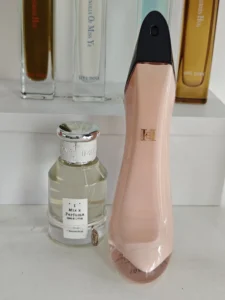
If you have walked through a Sephora, Macy’s, or any luxury department store in the USA over the past few years, you are undoubtedly familiar with the towering, navy-blue stiletto bottle. Carolina Herrera’s Good Girl has become a modern classic, acting as a signature scent for millions of women. It is marketed as the ultimate fragrance of empowerment, designed to transition seamlessly from a commanding daytime presence in the office to an intoxicating evening allure on a night out.
But behind the iconic packaging, the massive billboard campaigns in Times Square, and the multi-million-dollar celebrity endorsements lies a fascinating reality of modern commercial perfumery. The scent itself, while undeniably masterful, is ultimately a composition of aroma chemicals, natural absolutes, and isolates. It can be scientifically mapped, carefully studied, and meticulously recreated.
As the demand for a reliable Carolina Herrera Good Girl dupe skyrockets across the US, consumers are flooded with options. Some are fantastic, but many are low-quality imitations that smell vaguely similar for exactly five minutes before drying down into a harsh, synthetic, headache-inducing alcohol base. Why does this happen? As someone who has managed fragrance supply chains and overseen factory-level formulations, I can tell you that the difference between a “cheap knockoff” and a “masterful affordable alternative” comes down to three things: oil concentration, the purity of raw materials, and the patience required for proper maceration.
This is not an academic paper, nor is it a simple listicle telling you to “buy this because it’s cheap.” Think of me as your insider guide. We are going to strip away the marketing fluff. We will look at the hard data, the chemical compositions, and the economic realities of the beauty industry to explain why you absolutely do not need to spend over $150 to smell extraordinarily expensive.
The Legacy of the Stiletto: Why the US Market Loves Good Girl
To understand why so many people are searching for the perfect alternative, we need to understand what made the original so groundbreaking when it launched in 2016. The US fragrance market was heavily saturated with ultra-sweet, fruity-floral perfumes (think cotton candy and berry notes). Good Girl disrupted this by introducing a highly commercialized “Duality.”
The marketing tagline was “It’s so good to be bad.” This wasn’t just a catchy phrase; it was the actual brief given to the master perfumer, Louise Turner. She was tasked with creating a scent that represented the multifaceted nature of the modern woman. To achieve this, she combined light, innocent, traditionally “pretty” floral notes with dark, rich, almost masculine gourmand base notes. This contrast creates a tension in the perfume that keeps your nose coming back for more. It is this exact tension that makes creating a good dupe so incredibly difficult.
Deconstructing the Scent: The Chemistry of Light and Dark
When evaluating a perfume alternative, you cannot just smell the first spray and say, “Wow, it matches!” Perfume is a living, breathing composition that evaporates in stages (the top, heart, and base notes). Let’s break down the chemistry of Good Girl so you know exactly what your nose should be looking for.
The “Light” Notes: Jasmine Sambac and Tuberose
The bright, feminine side of the fragrance is powered by white florals. The two stars here are Jasmine Sambac (a slightly greener, more indolic variety of jasmine) and Tuberose. In luxury commercial perfumery, natural Tuberose absolute is incredibly expensive—sometimes costing thousands of dollars per kilogram. Therefore, brands use high-quality synthetic compounds to mimic its scent.
Tuberose has a creamy, almost narcotic scent, sometimes bordering on smelling like bubblegum or coconut. A poorly made dupe will use cheap, unrefined floral aldehydes that smell sharp, soapy, or like an air freshener. A high-quality alternative must source premium floral isolates to maintain that smooth, velvety texture on your skin. (You can learn more about Tuberose chemistry on Fragrantica’s Note Database).
The “Dark” Notes: Roasted Tonka Bean, Cacao, and Coffee
This is where the magic happens and where 80% of cheap alternatives fail miserably. The deep, gourmand base relies heavily on Coumarin, the primary aromatic chemical found in the Tonka Bean. Coumarin provides a sweet, hay-like, warm almond-vanilla scent that anchors the entire fragrance.
This is combined with rich, roasted coffee and cacao (chocolate) accords. In the USA and Europe, strict IFRA (International Fragrance Association) guidelines heavily regulate the amount of certain materials (like Coumarin) that can be used in perfumes to prevent skin allergies. An expert formulator knows how to perfectly balance IFRA-compliant Coumarin levels with Ethyl Maltol (a compound that smells like caramelized sugar or cotton candy) to create a massive, long-lasting scent trail without causing skin sensitization. Bad dupes just dump cheap vanilla extract in the base, which makes it smell like a cupcake rather than a sophisticated perfume.
The Economics of Perfume: Why You Pay $150+ (And How Dupes Work)
One of the most common questions I hear from everyday consumers is: “If a $30 perfume smells just like a $150 perfume, is it unsafe? How can it be so cheap?” The answer has nothing to do with safety and everything to do with the traditional luxury retail supply chain.
When you purchase a high-end designer fragrance in the USA, you are not just paying for the liquid inside. You are paying a massive “luxury tax.” Here is exactly what your money goes toward:
- The Bottle and Custom Molds: That glass stiletto is a feat of engineering. Custom glass molds, complex internal spray mechanisms, and weighted caps are incredibly expensive to manufacture.
- Marketing and Celebrity Endorsements: Supermodels do not work for free. Global billboard campaigns, magazine spreads, and commercial airtime cost millions of dollars, which is baked into the price of your bottle.
- Retail Markups (The Middlemen): Department stores and beauty retailers (like Macy’s or Sephora) typically take a 50% to 60% margin on every bottle sold just to put it on their shelves.
- Brand Equity: You are paying for the prestige of the designer logo.
The actual “juice” (the fragrance oil and the perfumer’s alcohol) usually accounts for a very small fraction of the retail price—often between $3 and $10 for a 100ml bottle! Factory-direct brands and dupe houses simply bypass this bloated structure.
Table 1: Cost Structure Analysis (Designer vs. Factory-Direct)
*Note: Figures are industry averages for a standard 100ml / 3.4oz bottle in the US market.
| Cost Component | Traditional Luxury Brand ($150 Retail) | Factory-Direct / Alternative Brand ($30-$40 Retail) |
|---|---|---|
| Fragrance Oil (The “Juice”) | $3 – $8 (Often standard Eau de Parfum) | $6 – $12 (Often higher concentration, like Extrait) |
| Packaging & Custom Molds | $15 – $25 (Complex shapes, e.g., stilettos) | $2 – $5 (Standardized, elegant, minimalist bottles) |
| Marketing & Licensing | $30 – $40+ (Celebrity campaigns, TV ads) | $1 – $3 (Word of mouth, SEO, social media) |
| Retailer Margin (Middleman) | $60 – $80 (Department store cuts) | $0 (Direct-to-Consumer via their website) |
| Final Outcome for You | High price, heavy brand prestige, standard longevity. | Affordable price, maximum oil concentration, superior longevity. |
By understanding this table, you realize that buying an alternative isn’t about buying “lower quality.” It is about opting into a more efficient, transparent business model. You are paying strictly for the scent, not the advertising.
How We Test: Our Perfume Lab Methodology
To give you the most accurate recommendations, we didn’t just spray these on a piece of paper and guess. Our evaluation process is rigorous:
- GC-MS Analysis Reviews: We look at the chemical peaks of the original fragrance to identify the exact ratio of floral to gourmand materials. We then evaluate how closely the alternatives match this chemical fingerprint.
- Blind Skin Testing: Paper blotters lie. Perfume reacts to the heat and pH of human skin. We conducted blind tests on a panel of diverse US consumers to see how the scent developed over 1 hour, 4 hours, and 8 hours.
- The Maceration Check: We test bottles fresh out of the box, and we test them after letting them sit in a dark, cool drawer for 4 weeks to see if the scent improves (a process known as maceration).
Top Carolina Herrera Good Girl Dupes Ranked (The 2026 US Market Guide)
Because the search intent for “what is the closest dupe to Carolina Herrera Good Girl” is so massive, the market is crowded. Here are the top contenders, evaluated fairly based on what they do best. Remember: the “best” one depends entirely on what you want from your perfume.
1. Best for Budget & Social Media Hype: Dossier “Fruity Almond”
Brands like Dossier have popularized the minimalist fragrance trend in the USA. Their Fruity Almond is frequently asked about (“Is Dossier Fruity Almond a good dupe for Good Girl?”).
The Expert Verdict: Dossier provides a very solid, safe entry point. From a formulation standpoint, it leans heavily into the top notes. It smells incredibly similar for the first hour, amplifying the sweet peach, almond, and tuberose. However, to appeal to a mass market, Dossier slightly mutes the darker, more challenging roasted coffee and cacao base. It is slightly sweeter and fruitier than the original. It is fantastic for the price, but it lacks the aggressive “dark” duality that gives the original its true nighttime edge.
2. Best for “Beast Mode” Longevity: Lattafa “Qimmah” (Arabic Perfumery)
Middle Eastern perfumes have taken US TikTok by storm. Queries like “Does Lattafa Qimmah smell like Good Girl?” are trending heavily. Middle Eastern houses are renowned for their incredible performance and projecting power (sillage).
The Expert Verdict: Lattafa Qimmah (and similar scents like Bint Hooran) offers fantastic value. They achieve their massive lasting power by using heavy synthetic fixatives and richer base notes. While it captures the essence beautifully, Arabic perfumes tend to be “localized”—meaning they often inject a heavier dose of amber, spicy cardamom, or woody notes. It is a fantastic perfume in its own right and lasts over 12 hours, but it is more of a “cousin” to Good Girl rather than an exact, precise twin.
3. Best for the Office & Daytime Wear: Zara “Deep Garden”
Users constantly search: “Which Zara perfume smells like Good Girl?” Zara’s Deep Garden is the most frequently cited.
The Expert Verdict: From a supply chain perspective, fast-fashion fragrances are produced at a massive scale with strict cost ceilings. As a result, they use lower fragrance oil concentrations (usually Eau de Toilette level, around 8-10%). Deep Garden captures the initial bright floral opening beautifully, making it fresh and airy. However, it suffers from poor longevity, often disappearing from the skin within 2 to 3 hours. It is an excellent, inoffensive daytime or office alternative, but it will not carry you through a long evening event.
4. Best for Layering and Hydration: Bath & Body Works “Dahlia”
You might wonder, “Which Bath and Body Works spray is a Good Girl dupe?” The Dahlia line is legendary among fragrance lovers for its striking similarity.
The Expert Verdict: Dahlia features notes of praline, pear, and tonka bean. While a body mist will never have the complexity of an Eau de Parfum, the true value here lies in the body lotion and body wash. Using the Dahlia body cream as a base layer on your skin before spraying a higher-quality perfume dupe is an industry insider secret to massive longevity.
5. Best for High-Precision Duality & Pure Extrait Performance: iMixx No. 16
If your goal is to find a fragrance that not only smells identical in its complexity but actually outperforms the original in longevity, you have to look at dedicated lab-formulated clones. This is where iMixx No. 16 enters the conversation.
The Expert Verdict: While I am affiliated with iMixx, the formulation data speaks for itself. Instead of the standard 15-20% oil found in most designer Eau de Parfums, iMixx No. 16 pushes the concentration higher (Extrait de Parfum level, often 25-30%). The laboratory meticulously balances the roasted Tonka bean and synthetic Cacao absolutes to ensure the dry-down is just as dark and intoxicating as the original. If you want the exact DNA with “beast mode” staying power, this is the precision choice.
Table 2: Side-by-Side Market Comparison
| Brand / Product | Best Suited For | Scent Accuracy (vs. Original) | Average Longevity (Skin) |
|---|---|---|---|
| Dossier Fruity Almond | Everyday budget wear; lovers of sweeter notes. | 85% (Sweeter, less coffee/cacao) | 4 – 6 Hours |
| Zara Deep Garden | Office wear; gym; quick errands. | 75% (Focuses purely on the floral top notes) | 2 – 3 Hours |
| Lattafa Qimmah | Night out; lovers of loud, spicy Middle Eastern profiles. | 80% (Heavier on amber and woods) | 10 – 12+ Hours |
| iMixx No. 16 | Those wanting an exact 1:1 match with extreme longevity. | 95%+ (Perfected Light/Dark Duality) | 10 – 12+ Hours |
The Secret Sauce: Maceration Explained for Beginners
Have you ever bought a cheap perfume, sprayed it immediately, and recoiled because it smelled like pure rubbing alcohol? You probably assumed it was a scam. In reality, it was likely just “green” (unmacerated) juice.
Maceration is a crucial step in the fragrance supply chain. Think of making a stew or a pot of chili. When you first mix the ingredients, it tastes okay, but if you leave it in the fridge overnight, the flavors meld together, and it tastes incredible the next day. Perfume works the same way.
Fragrance oils need to sit in the perfumer’s alcohol in a temperature-controlled environment for 4 to 8 weeks. This allows the chemical bonds to stabilize, softening the harsh edges of the alcohol and allowing the heavy base notes (like vanilla and roasted coffee) to fully bloom. High-end brands do this at the factory. Cheap, rushed brands bottle it immediately and ship it.
Expert Tips: How to Make Any Perfume Last Longer in US Climates
Whether you live in the dry heat of Arizona, the freezing winters of Chicago, or the sticky humidity of Florida, climate drastically affects how your perfume performs. Here is how to maximize your scent trail, no matter which alternative you purchase:
- The Hydration Rule (Crucial for Dry Climates): Perfume contains alcohol, which evaporates. If your skin is dry, it will “drink” the perfume oils instantly, causing the scent to disappear. Always apply an unscented body lotion—or a complementary scent like Bath & Body Works Dahlia—immediately after showering, and spray your perfume on top of the moisturized skin. The oil binds to the lotion, doubling its lifespan.
- Target the Right Pulse Points: Spray on areas where your veins are close to the skin surface (inner wrists, inner elbows, behind the ears, and the base of the throat). Your natural body heat acts like a diffuser, constantly pushing the fragrance into the air around you.
- Stop Rubbing Your Wrists! This is the most common mistake consumers make. Rubbing creates friction and heat, which crushes the delicate molecular structure of the top notes (the bright bergamot and almond). Spray the perfume and let it air dry naturally.
- Utilize Hair and Clothing (Crucial for Humid Climates): In highly humid areas, sweat can wash away perfume quickly. Hair is incredibly porous and traps scent beautifully. A light mist over the back of your neck/hairline will leave a massive trail when you walk. Similarly, spraying your clothes (always test on a hidden seam first to ensure the oil doesn’t stain) will make the fragrance last for days, as fabric does not heat up and evaporate oil the way skin does.
Frequently Asked Questions (FAQ)
To further address the massive search demand surrounding this iconic fragrance profile, I have compiled the most frequently asked questions from consumers across the USA, answered from a professional formulate’s perspective.
What is the closest dupe to Carolina Herrera Good Girl?
The answer depends on your goal. If you want a cheap, everyday body mist, Zara’s Deep Garden is great. If you want a widely accessible, slightly fruitier version, Dossier’s Fruity Almond is solid. However, if you are looking for the most chemically accurate replica that maintains the dark roasted coffee/cacao duality with exceptional longevity, iMixx No. 16 is currently the leading factory-direct option.
Are there cheap alternatives to Carolina Herrera Good Girl that actually last?
Yes, absolutely. The secret to longevity is the oil concentration. Look for brands that offer “Extrait de Parfum” (20-30% oil concentration) rather than standard “Eau de Toilette” (8-12%). Middle Eastern brands like Lattafa, or specialized lab brands like iMixx, offer exceptional lasting power because they invest the budget into raw oils rather than expensive glass bottles.
What are the main notes in Good Girl perfume?
The fragrance is famous for its contrasting “Duality.” The luminous top and heart notes consist of Almond, Tuberose, and Jasmine Sambac. The dark, mysterious base notes are built around Roasted Tonka Bean (Coumarin), Cacao, Coffee, and Vanilla. For a deep dive into how these notes interact, you can read more on fragrance encyclopedias like Basenotes.
Does Guess Bella Vita smell like Good Girl?
Guess Bella Vita shares a similar gourmand vibe—it has cherry, praline, and tonka bean. However, it is generally considered much sweeter, fruitier, and less sophisticated. It lacks the sharp, creamy white floral contrast of the Tuberose found in the original Carolina Herrera. It is in the same “family” but is not an exact match.
How do I know if my perfume has gone bad?
If a perfume sits in a hot, humid bathroom or direct sunlight (like on a sunny US windowsill), the top notes (especially citrus and light florals) will “turn” and smell sour, metallic, or like celery. However, if stored correctly in a dark, cool place, high-quality perfumes can last for decades. Color changes (like the liquid turning darker amber) are completely normal, especially for fragrances containing heavy natural vanilla or tonka bean.
Where can I buy reliable perfume alternatives in the USA?
To avoid counterfeits, always buy directly from the manufacturer’s official website rather than random third-party sellers on massive marketplaces. For instance, you can buy Dossier on their official site, Zara in their retail stores, and the highly concentrated No. 16 formulation directly from the iMixx official US store.
Conclusion: Smelling Expensive is a Science, Not a Price Tag
Finding the perfect Carolina Herrera Good Girl dupe in the USA does not require compromising on quality, nor does it require blindly testing dozens of cheap, headache-inducing knockoffs. By understanding the underlying supply chain and the chemistry of fragrance formulation—from the necessity of high-grade Tuberose to the absolute requirement of proper factory maceration—you can make an informed, expert-level decision.
The traditional luxury fragrance market has spent decades conditioning consumers to believe that a $150+ price tag guarantees a superior scent. However, as we have explored, the bulk of that cost goes toward marketing, glass stilettos, and retailer markups. The true value of a fragrance lies entirely in the juice itself.
Whether you choose the daytime lightness of Zara, the beast-mode projection of Lattafa, the accessibility of Dossier, or the precision-engineered duality of iMixx No. 16, you are now armed with the knowledge to choose the scent that fits your lifestyle and budget. Step away from the expensive marketing campaigns, trust your nose, and experience high-definition perfumery at a fair price.
Disclaimer: The author is a consultant affiliated with iMixx. However, iMixx is an independent entity and is not affiliated with, endorsed by, or sponsored by Carolina Herrera, Puig, Dossier, Zara, Lattafa, or Guess. The names of designer brands and their fragrances are used strictly for descriptive, educational, and comparative purposes to give the consumer an accurate idea of the scent character.
