

Blog, Designer Dupe Reviews
How to Find the Best Carolina Herrera Good Girl Dupe in the USA: A Supply Chain Expert’s Guide
Jul
How to Find the Best Carolina Herrera Good Girl Dupe in the USA: A Perfume Industry Insider’s Guide
Transparency & Trust Disclosure: As an industry insider, I currently oversee supply chain and formulation standards at IMIXX Fragrances. However, this guide was written to be an objective, educational resource. In our quest to find the best alternatives to designer scents, my team and I conducted blind tests of multiple popular brands on the market, including our competitors. We believe in letting the data and the juice speak for themselves. You will find honest reviews of Zara, Dossier, ALT, and others below, alongside our own product, to help you make the best choice for your budget and skin type.
Article Summary & Quick Takeaways
Are you looking for a long-lasting alternative to Carolina Herrera’s iconic Good Girl perfume without paying the steep $150+ luxury price tag? You are not alone. In this comprehensive, beginner-friendly guide, we break down exactly why this fragrance is so intoxicating (and expensive) by looking at its unique blend of roasted Tonka bean and bright Jasmine.
We take you behind the scenes of a fragrance factory to explain how designer perfumes are priced and why so many cheap dupes smell like harsh rubbing alcohol. We also share the results of our 45-day blind testing panel, comparing top US market alternatives—including Zara Deep Garden, Dossier Fruity Almond, ALT Stiletto, and IMIXX No. 16. Complete with easy-to-read comparison tables and a detailed FAQ, this guide will arm you with the insider knowledge you need to buy a high-quality perfume that actually lasts all day.
The Stiletto Phenomenon: Why We All Love Carolina Herrera Good Girl
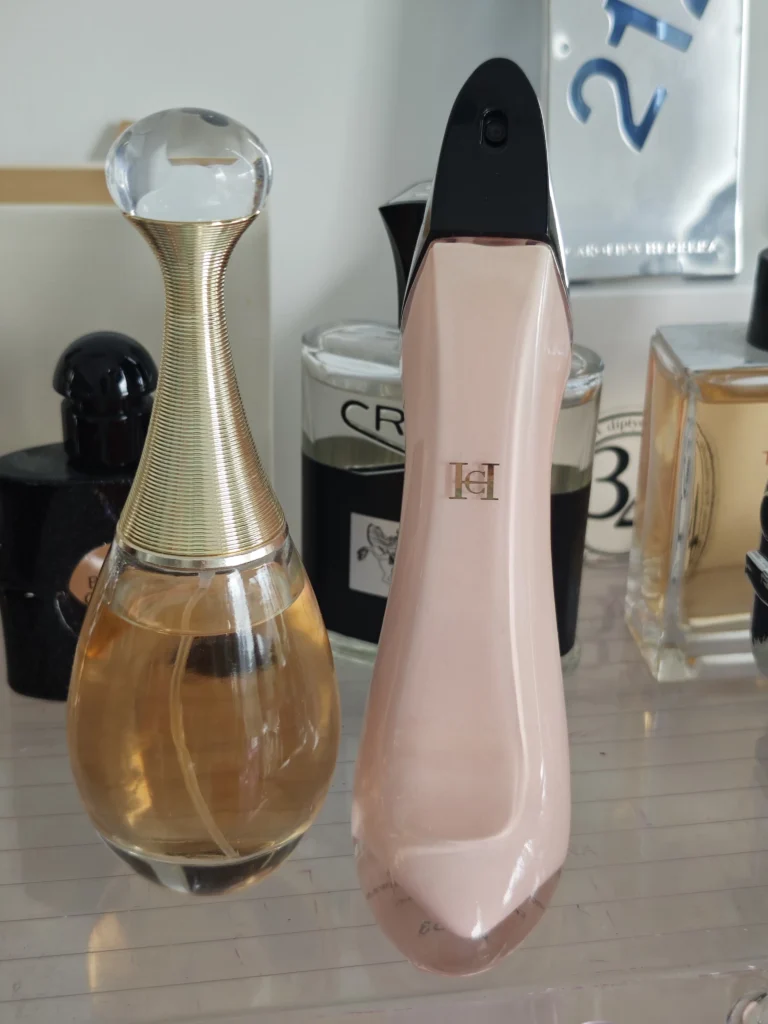
If you have walked through a Sephora, Macy’s, or Ulta anywhere in the USA over the last few years, you have seen it: the towering, midnight-blue glass stiletto with the gold heel. Carolina Herrera launched Good Girl in 2016, created by master perfumer Louise Turner, and it almost instantly became a global sensation. But what is it about this specific perfume that has everyday consumers and fragrance collectors alike so obsessed?
The marketing slogan for the fragrance is “It’s so good to be bad.” This perfectly captures the essence of the perfume, which is built on a concept perfumers call olfactory duality. It is designed to represent the multifaceted nature of a modern woman. It isn’t just a sweet, innocent floral perfume, nor is it a dark, heavy, overpowering winter scent. It is a masterful tightrope walk between the two.
However, that beautiful stiletto bottle comes with a heavy price tag. In the current US economy, spending upwards of $130 to $170 on a 3.4 oz bottle of perfume is a significant luxury investment. Because it is such a popular “signature scent” and “date night” fragrance, people go through bottles quickly. This has led to a massive surge in searches for the “best Carolina Herrera Good Girl dupe.” Consumers want the badass, confident vibe of the original, but they want it at a price point that allows for everyday wear.
Deconstructing the Scent: What Does Good Girl Actually Smell Like?
Before you can find a good alternative, you have to understand what you are trying to replicate. To the everyday nose, Good Girl smells like a sexy, sweet, slightly dark floral coffee shop. But in the laboratory, we break it down into a highly specific pyramid of fragrance notes. For an excellent, unbiased breakdown of these individual notes, fragrance encyclopedias like Fragrantica or Basenotes are fantastic resources for consumers.
The Bright Top and Heart Notes (The “Good” Girl)
When you first spray the original, you are greeted by an immediate burst of brightness. This is primarily driven by:
- Almond and Lemon/Bergamot: The almond provides a creamy, slightly nutty sweetness, while the citrus gives it a fresh, waking-up quality.
- Tuberose and Jasmine Sambac: These are the stars of the show. Tuberose is a heavy, creamy white flower that is notoriously expensive to extract. Jasmine Sambac is sweet but slightly “indolic” (which means it has a raw, almost animalic depth to it). This is what gives the perfume its elegant, feminine, and slightly soapy cleanliness.
The Dark Base Notes (The “Bad” Girl)
As the perfume dries down on your skin over the next few hours, the bright florals take a back seat, and the deep, roasted base notes emerge to give the perfume its incredible longevity.
- Roasted Tonka Bean: This is the most crucial ingredient. Tonka bean contains a compound called Coumarin, which smells like a mix of vanilla, sweet hay, and almonds. It is incredibly warm and addictive.
- Cacao and Coffee: These notes add a gourmand (food-like) bitterness. They prevent the perfume from becoming overly sweet or cloying, grounding it with a dark, chocolatey, roasted aroma.
- Praline, Woods, and Musk: These act as “fixatives,” anchoring the lighter floral notes to your skin so they don’t evaporate into thin air after twenty minutes.
The reason many cheap dupes fail is that they only manage to copy the bright, synthetic floral opening, completely failing to balance the expensive, roasted depth of the Tonka and Cacao base.
Inside the Factory: Why Do Designer Perfumes Cost So Much?
To understand how a good alternative can exist at a fraction of the price, we have to pull back the curtain on the fragrance supply chain. When you buy a luxury perfume at a department store, you are paying for an entire ecosystem of expenses, not just the liquid inside the glass.
Here is a simplified look at the cost structure of traditional luxury perfumery versus direct-to-consumer (DTC) brands:
- The Bottle and Packaging: Creating a custom glass mold shaped like a high heel requires millions of dollars in engineering, tooling, and specialized manufacturing. The box, the velvet liners, and the gold caps all add massive weight and shipping costs. Standard, elegant, off-the-shelf cylinder bottles used by alternative brands cost pennies on the dollar in comparison.
- Celebrity Marketing and Royalties: Designer houses spend tens of millions on global ad campaigns featuring supermodels (like Karlie Kloss for Good Girl), TV spots, and billboard space. Furthermore, the fashion house takes a hefty royalty fee from the beauty conglomerate that actually manufactures the scent.
- The Retail Markup: Brick-and-mortar stores in the USA (like Sephora, Ulta, or Macy’s) need to pay for floor space, lighting, and staff. To do this, they typically take a 50% to 60% margin on the retail price. If a perfume sells for $150, the store keeps $75.
When you strip away the stiletto bottle, the celebrity ads, and the retail middleman, the actual cost of the premium fragrance oils (the “juice”) and the perfumer’s alcohol is surprisingly affordable. This is the exact gap in the market that high-quality alternative brands exploit.
The Science of a Good Dupe vs. A Bad Dupe (Explained Simply)
If you’ve ever bought a cheap knock-off perfume at a discount store, sprayed it, and immediately coughed because it smelled like hand sanitizer, you’ve experienced the dark side of the dupe market. How do professionals avoid this? It comes down to three main factors: Technology, Concentration, and Time.
1. Gas Chromatography-Mass Spectrometry (GC-MS): The Recipe Scanner
Modern perfumery relies on incredible technology. We use machines called GC-MS. Think of it like a highly advanced, microscopic recipe scanner. You put a drop of the original Good Girl into the machine, and it prints out a graph showing exactly which chemical molecules are present (like Linalool, Ethyl Maltol, etc.) and in what quantities.
However, the machine isn’t perfect. It struggles to identify complex, naturally derived essential oils. This is why a cheap brand that *only* relies on a machine will produce a perfume that smells “flat” or “metallic.” It requires an experienced, human Master Perfumer to take that machine data and tweak the formula with high-quality natural isolates so it smells alive and rich.
2. The Concentration Game: EDP vs. Extrait
Perfume is a mixture of pure fragrance oil and a solvent (usually perfumer’s alcohol). The concentration of oil dictates how long the scent lasts.
- Eau de Toilette (EDT): 8% to 15% oil. Lasts 3 to 5 hours.
- Eau de Parfum (EDP): 15% to 20% oil. Lasts 5 to 8 hours. (The original Good Girl is an EDP).
- Extrait de Parfum (Pure Perfume): 20% to 40% oil. Lasts 10+ hours.
Many fast-fashion brands sell their dupes as EDTs or very weak EDPs to save money on expensive oils. You get a blast of alcohol, and the scent vanishes before your lunch break.
3. Maceration: The Secret Ingredient is Time
Imagine making a big pot of chili or a complex stew. It always tastes better the second day, right? That’s because the ingredients need time to mingle and bond together. Perfume is exactly the same. The process of letting fragrance oils and alcohol sit in a dark, cool vat for several weeks is called maceration.
Mass-market, low-tier dupe companies skip this step. They mix the chemicals, bottle them immediately, and ship them out to hit fast trends. This results in a harsh, unblended scent. Premium alternative brands allow their batches to macerate for 4 to 6 weeks. This smooths out any harsh alcohol edges, creating a luxurious, rounded opening spray.
Our Testing Methodology: Finding the Best Alternatives on the US Market
To ensure this guide is genuinely helpful, we couldn’t just rely on marketing claims. We needed empirical data. Our team set up a 45-day testing panel to evaluate the most popular Good Girl alternatives available to US consumers.
The Parameters:
- The Testers: A panel of 5 individuals (3 women, 2 men to test skin chemistry variance), representing dry, normal, and oily skin types (which drastically affects how perfume wears).
- The Process: Blind sniff tests were conducted on standard paper blotters and directly on the skin. We evaluated the opening (first 10 minutes), the heart (1-3 hours), and the base dry-down (4-8+ hours).
- Safety & Standards: We also verified if the brands adhered to IFRA (International Fragrance Association) standards, which ensure the ingredients are non-toxic and skin-safe.
The Ultimate Review: Top Carolina Herrera Good Girl Dupes Tested
Here is our honest, unbiased breakdown of the most popular alternatives on the market right now, ranked and reviewed so you can choose the one that fits your needs.
1. Zara – Deep Garden
Zara has become famous on TikTok for their highly affordable fragrance line. Deep Garden is widely touted as a Good Girl dupe.
- The Pros: It is incredibly accessible. You can walk into almost any mall in the USA and buy it. It is very affordable (usually around $20-$25). The opening notes are remarkably similar; it captures the bright white florals beautifully.
- The Cons: It completely lacks the deep, roasted Tonka and Coffee base notes. It is also an Eau de Toilette with very poor longevity. On our testers, it faded to a faint skin scent within 2.5 hours.
- Best For: Teenagers on a strict budget, or someone who just wants a quick body spray for running errands.
2. Dossier – Fruity Almond
Dossier is one of the pioneers of the modern, transparent dupe market, heavily advertising online and now found in Walmart stores across the US.
- The Pros: The scent accuracy is very high (around 85%). They nail the almond and tuberose balance perfectly. The minimalist magnetic bottle is a nice touch, and the price point ($29-$39) is solid.
- The Cons: While it performs better than Zara, it still leans a bit synthetic in the dry-down. It lacks the rich, oily depth of the original’s Cacao notes. Expect about 5 hours of longevity before needing to reapply.
- Best For: The casual, everyday consumer who wants a highly accurate, mid-tier option that is easy to purchase at a big-box retailer.
3. ALT. Fragrances – Stiletto
ALT is another major player in the online alternative fragrance space, known for fast shipping and a huge catalog.
- The Pros: A very respectable clone that projects loudly for the first two hours. The coffee note in ALT’s version is slightly more pronounced, which some users actually prefer over the original.
- The Cons: Our panel noted a slight “alcohol blast” upon the initial spray, suggesting it might benefit from longer maceration times at the factory. It settles down nicely after 15 minutes, but the opening can be a bit harsh.
- Best For: People who love the coffee aspect of Good Girl and want a strong projector for a night out.
4. Lattafa – Bayaan (and various Middle Eastern Clones)
Arabic perfume houses are currently taking the US market by storm, offering incredible value and massive projection.
- The Pros: The value for money is insane. The packaging is often elaborate, and the longevity is usually nuclear. Middle Eastern houses do not skimp on heavy base notes.
- The Cons: They rarely do 1:1 exact copies. They usually add a “Middle Eastern twist”—perhaps a touch of oud, extra spices, or heavy musk. It is “inspired by” rather than an exact dupe. Availability can be spotty, often requiring blind buys from Amazon or discount sites.
- Best For: The adventurous fragrance lover who wants a scent similar to Good Girl but louder, spicier, and longer-lasting.
5. IMIXX Fragrances – No. 16 (Inspired by Good Girl)
(Transparency Note: This is formulated by our team at IMIXX. We present the objective data regarding its formulation specs below, compared alongside the others).
We designed IMIXX No. 16 specifically to address the number one complaint consumers have with dupes: lack of longevity and harsh openings.
- The Pros: Unlike the EDPs and EDTs on this list, No. 16 is formulated as an Extrait de Parfum (30%+ premium fragrance oil concentration). This dense formulation, combined with a strict 4-to-6-week factory maceration process, means there is zero alcohol burn upon spraying. The rich, creamy almond and roasted Tonka are incredibly deep and smooth. In our skin tests, it consistently lasted 10+ hours, outperforming even the designer original on dry skin types.
- The Cons: It is a direct-to-consumer online exclusive. You cannot smell it in a physical store before buying, and it comes in a sleek, minimalist glass bottle rather than a novelty stiletto shape.
- Best For: The serious fragrance enthusiast who prioritizes extreme longevity, high oil concentration, and smooth, premium ingredients over flashy packaging. You can explore the full range of Extrait formulations at the IMIXX brand homepage.
Comparative Analysis Tables
To help you visualize the differences quickly, we have compiled our lab and panel data into two easy-to-read tables.
Table 1: Cost & Supply Chain Breakdown
| Brand / Category | Approx. US Retail Price (100ml / 3.4oz) | Concentration Level | Maceration Process | Where Your Money Goes |
|---|---|---|---|---|
| Carolina Herrera (Original) | $130 – $160 | Eau de Parfum (15-20%) | Excellent (Fully aged) | Custom Bottle, Celebrity Ads, Retail Margins |
| Zara (Fast Fashion) | $20 – $25 | Eau de Toilette (8-12%) | Poor (Rushed) | Mall Rent, Mass Production scale |
| Dossier (Standard Dupe) | $29 – $39 (50ml scaling) | Eau de Parfum (15-18%) | Fair (Standard) | Social Media Ads, Walmart placement |
| IMIXX No. 16 (Factory Direct) | ~$40 – $50 | Extrait de Parfum (30%+) | Excellent (4-6 Weeks) | High-quality Oils, Direct Manufacturing |
Table 2: Performance and Scent Accuracy Testing
| Product | Scent Accuracy (vs. Original) | Opening Experience (First 15 mins) | Skin Longevity (Average) | Best Feature |
|---|---|---|---|---|
| Carolina Herrera | 100% (The Benchmark) | Smooth, bright almond & coffee | 7 – 9 Hours | The iconic stiletto bottle |
| Zara Deep Garden | 65% | Sharp, highly floral, slight alcohol | 2 – 4 Hours | Extremely budget-friendly |
| Dossier Fruity Almond | 85% | Good balance, very slightly synthetic | 5 – 6 Hours | Easy to find in US stores |
| ALT. Stiletto | 80% | Strong coffee, mild alcohol blast | 5 – 7 Hours | Strong initial projection |
| IMIXX No. 16 | 95%+ | Rich, smooth, zero alcohol burn | 10 – 12+ Hours | Extrait concentration longevity |
Expert Guide: How to Make Your Perfume Last All Day Long
Even if you purchase a highly concentrated perfume like IMIXX No. 16 or the original Carolina Herrera, your personal application habits dictate how well it performs. The US climate varies wildly—from dry Arizona heat to humid Florida summers—so optimizing your routine is key. As a formulation expert, here are my top tips for making your fragrance last:
- The Skin Canvas is Everything (Moisturize!): Fragrance contains alcohol, which evaporates. If your skin is dry, it will essentially “drink” the fragrance oils, causing the scent to disappear rapidly. Always apply an unscented body lotion (like CeraVe or Cetaphil) right out of the shower before spraying. Pro Tip: Rubbing a tiny dab of Vaseline (petroleum jelly) on your pulse points before spraying will lock the oils onto your skin for hours.
- Stop Rubbing Your Wrists Together: This is the most common mistake people make! When you spray perfume on your wrists and rub them together aggressively, the friction creates heat. This heat literally breaks down the delicate molecular bonds of the top notes (like the Lemon and Almond in Good Girl), ruining the scent progression. Spray, and let it air dry naturally.
- Target the Right Pulse Points: Your pulse points radiate body heat, which helps project the fragrance into the air. The standard spots are the inner wrists and the neck. But to create a “scent bubble,” also spray the inside of your elbows, behind your knees, and on your collarbones.
- Scent Your Clothes and Hair: Skin chemistry alters fragrance over time. Fabric does not. Spraying a little perfume on your scarf, sweater, or inside your jacket will ensure the scent lasts for days, smelling exactly as it did in the bottle. Alternatively, spray a little on your hairbrush and run it through your hair; hair is porous and holds scent beautifully.
- Storage Matters: Stop keeping your beautiful perfumes in a hot, steamy bathroom! Heat, humidity, and UV light from the sun will break down the essential oils, causing the perfume to sour or lose its potency within months. Store your bottles in a cool, dark place, like a bedroom dresser drawer or a closet.
Frequently Asked Questions (FAQ)
Conclusion: The Smart Way to Smell Luxurious
The fragrance industry is a masterclass in psychology and marketing. We are trained to believe that the heavier the glass bottle and the more famous the celebrity endorsing it, the better the perfume must be. But as we’ve explored through supply chain economics and olfactory chemistry, the reality is much more nuanced.
You absolutely can achieve the confident, seductive, and sophisticated aura of Carolina Herrera Good Girl without draining your bank account. The trick is knowing what to look for: high fragrance oil concentrations (EDP or Extrait), proper maceration, and brands that invest their budget into the liquid rather than the packaging.
Whether you choose the ultra-budget Zara option for a quick thrill, the accessible Dossier for everyday wear, or our own meticulously formulated IMIXX No. 16 for unparalleled, all-day Extrait de Parfum performance, the choice is now yours. You are armed with the knowledge of a fragrance industry insider.
Stop paying for the marketing, and start paying for the scent. Happy sniffing!
Disclaimer: This article is an independent educational analysis of fragrance profiles, formulation chemistry, and supply chain economics. IMIXX Fragrances competes in the alternative fragrance market and is in no way affiliated with, endorsed by, or sponsored by Carolina Herrera, Zara, Dossier, ALT, or their respective parent companies. All designer trademarks and copyrights are the property of their respective owners and are used here purely for comparative and descriptive purposes.
