

Blog, Designer Dupe Reviews
How to Choose the Best Coco Chanel Mademoiselle Dupe: A Perfumer’s Guide to Quality, Longevity, and Price in the USA
May
Executive Summary
The search for the perfect best dupe for Coco Mademoiselle is one of the most common quests for fragrance enthusiasts in the USA today. Driven by rising retail costs and widespread consumer observations regarding reformulations and reduced longevity, shoppers are demanding better alternatives. But navigating the world of “dupes” can be overwhelming.
This comprehensive, consumer-friendly guide demystifies the fragrance industry. We will break down the iconic citrus-patchouli scent profile so you know exactly what you are smelling. We will explore the hidden economics of the perfume supply chain, explaining why luxury fragrances cost what they do and how modern laboratories create accessible alternatives using Gas Chromatography-Mass Spectrometry (GC-MS). Most importantly, to ensure you get the best value, we will objectively review and compare several of the most popular alternatives on the market—including Zara, Armaf, Dossier, and our own Imixx No. 14—highlighting the pros and cons of each. Finally, we provide actionable, expert tips on how to make your fragrance last all day on your skin.
1. The Enduring Allure: Why is Everyone Searching for a Coco Chanel Mademoiselle Alternative?
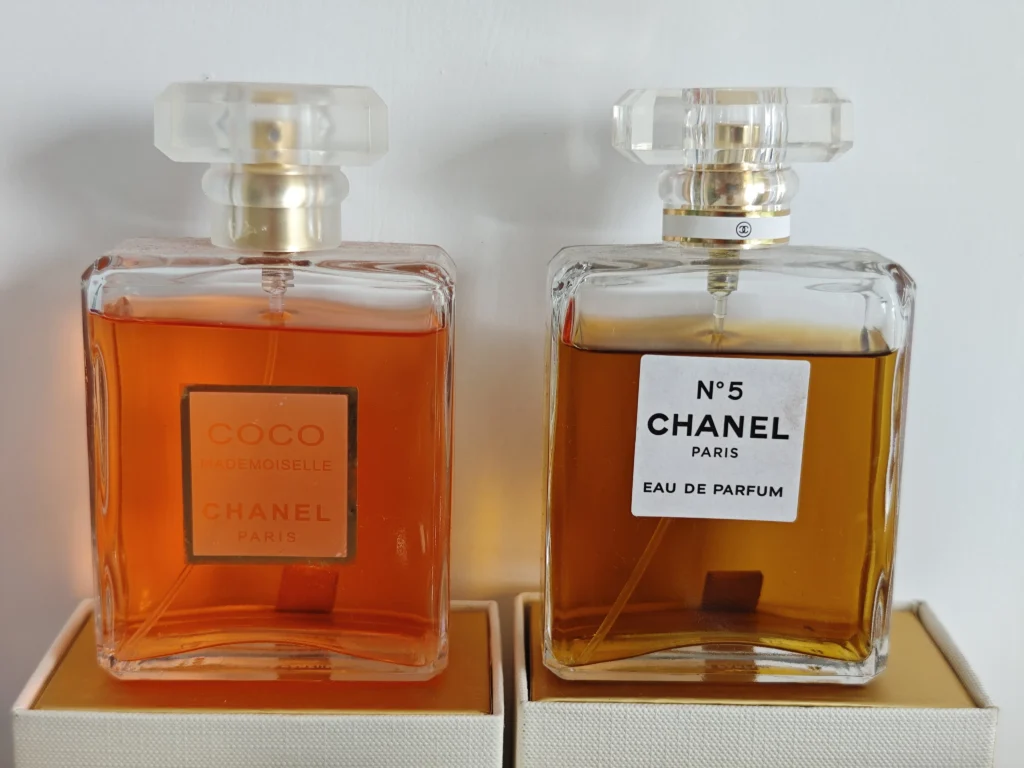
Walk into any department store in the USA, from Macy’s to Nordstrom, and you will undoubtedly encounter the iconic frosted glass and pink liquid of Chanel’s masterpiece. Launched originally in 2001 and crafted by legendary perfumer Jacques Polge, this fragrance completely revolutionized the “chypre” (pronounced sheep-ra) fragrance category. It took the traditionally heavy, mossy, and sometimes severe chypre structure and injected it with a luminous, youthful energy.
However, despite its legendary status, the demand for a reliable Chanel perfume alternative has skyrocketed in recent years. As someone who has spent over a decade analyzing market trends and supply chains, I see this shift driven by two massive factors that affect everyday consumers: pricing fatigue and the reality of industry reformulations.
The Hidden Economics of Luxury Perfume Pricing
Have you ever wondered what you are actually paying for when you spend $150 to $200 on a 50ml bottle of designer perfume? The reality of the fragrance supply chain might surprise you. In the traditional luxury model, the physical liquid inside the bottle—what we in the industry call the “juice”—typically represents only a tiny fraction of the final retail price, often between 5% and 10%.
Where does the rest of your money go? It funds a massive, complex ecosystem. You are paying for multi-million dollar celebrity endorsement campaigns, prime television advertising slots, full-page magazine spreads in Vogue or Harper’s Bazaar, intricate glass bottle manufacturing, and the heavy margins required by physical retail stores. Brands also build in a “prestige markup”—a psychological pricing strategy where a high price tag is used to signal exclusivity and luxury to the consumer.
For the average consumer in the USA who simply wants to smell elegant, clean, and put-together for the office or a date night, paying nearly $200 every few months is becoming economically unsustainable. This is exactly why the market for high-quality, scientifically formulated alternatives has exploded. Consumers are realizing they can buy the “juice” without paying for the billboard.
The Reformulation Reality: Why Does My Perfume Not Last Anymore?
If you browse fragrance forums like Basenotes or Reddit’s fragrance communities, you will see a recurring, frustrated question: “Did Chanel reformulate Coco Mademoiselle? It doesn’t last on my skin anymore!”
The short, objective answer is: Yes, almost all classic perfumes have been reformulated over the past two decades. But this is rarely done out of malice by the brands. The primary driver is the International Fragrance Association (IFRA). IFRA sets strict global guidelines to ensure the safety of fragrance ingredients. Over the years, they have heavily restricted or outright banned certain natural ingredients and synthetic molecules due to their potential to cause allergic skin reactions.
For example, certain types of oakmoss (a traditional fixative that makes perfumes last forever) and specific synthetic floral molecules (like Lyral and Lilial) have faced severe restrictions. When a master perfumer is forced to remove or reduce these heavy, long-lasting base notes, the overall longevity of the fragrance suffers. Many long-time users report that the modern batches of their favorite citrus-patchouli fragrances fade within 3 to 4 hours, a stark contrast to the 10-hour staying power they experienced in the early 2000s. This drop in performance, combined with rising prices, is the ultimate catalyst driving consumers to seek out robust alternatives.
2. Decoding the DNA: What Does Coco Mademoiselle Smell Like?
Before you can find the perfect best dupe for Coco Mademoiselle, you need to understand its architecture. It is not just a simple “floral” or “fruity” body spray. It is a masterclass in tension and balance, built on a classic three-tiered pyramid structure.
- The Top Notes (The Sparkling Hook): The moment you spray it, you are hit with a bright, effervescent burst. This is primarily driven by Sicilian orange, Calabrian bergamot, and a touch of grapefruit. In a laboratory setting, these are highly volatile molecules. They evaporate off the skin very quickly (usually within the first 15 to 30 minutes), but they are crucial for providing that initial, mouth-watering freshness that captures your attention.
- The Heart Notes (The Elegant Core): As the sharp citrus begins to mellow and evaporate, the “heart” of the perfume opens up. Here, you will find a lush, sophisticated bouquet of absolute rose, jasmine, and subtle hints of lychee. This phase lasts for several hours. It provides a deeply feminine, slightly soapy, and undeniably elegant aura. It is what makes the fragrance feel “expensive.”
- The Base Notes (The Sensual Anchor): This is the foundation of the fragrance and the secret to its addictive nature. The base relies heavily on Indonesian patchouli, Bourbon vanilla, Haitian vetiver, and white musk. Patchouli is a polarizing ingredient; in its raw form, it can smell like damp earth or a vintage hippie shop. But when fractionalized and purified (a process that removes the “dirty” aspects), it becomes an incredibly clean, woody, and slightly sweet anchor. The white musk acts as a fixative, binding all the other notes to your skin so they linger throughout the day.
3. The Science of the Scent: How Modern Alternatives are Made
You might be wondering, how can independent brands create a fragrance that smells so similar to a closely guarded designer secret? It comes down to modern analytical chemistry, specifically a process called Gas Chromatography-Mass Spectrometry (GC-MS).
As explained by scientific bodies like the American Chemical Society, GC-MS is a technique used to identify the different substances within a test sample. When a lab analyzes a designer perfume, the machine separates the liquid into its individual molecular components and creates a highly detailed graph. It acts like a high-tech recipe reader, telling the perfumer exactly which aroma chemicals (like Linalool, Limonene, or specific musks) are present and in what exact proportions.
However, having the recipe is only half the battle. The true artistry—and the difference between a terrible drugstore dupe and a high-quality alternative—lies in how the perfumer sources those ingredients and how they blend them. A machine cannot tell you the geographic origin of a natural rose oil, nor can it replicate the crucial aging process known as maceration.
The Crucial Step Most Cheap Dupes Skip: Maceration
If you have ever bought a very cheap perfume and thought it smelled like pure rubbing alcohol for the first five minutes, you have experienced a lack of maceration. Maceration is the fragrance industry’s equivalent of aging fine wine. Once the fragrance concentrate (the oils) is mixed with the perfumer’s alcohol, the mixture must sit in a temperature-controlled environment for several weeks—often 4 to 8 weeks.
During this time, complex chemical reactions occur. The alcohol bite softens, the harsh edges of the synthetic molecules round out, and the different notes seamlessly fuse together. Many fast-fashion brands and mass-market drugstore dupes completely skip this step to save money and rush the product to shelves. This results in a screechy, flat, and often headache-inducing scent. High-quality alternative brands, however, build maceration time into their production schedules to ensure a smooth, luxurious opening.
4. Evaluating the Market: An Objective Review of the Best Alternatives
To provide a truly useful guide for consumers in the USA, it is vital to look at the landscape objectively. The market is flooded with options, each with its own strengths and weaknesses. Here is a fair, comparative analysis of some of the most popular alternatives to help you make an informed decision.
1. The Fast-Fashion Option: Zara (Often referred to as Madame Glamour or similar iterations)
Zara is famous for releasing incredibly affordable fragrances that heavily nod to designer classics. Over the years, several of their releases have been touted as a Zara Coco Mademoiselle dupe.
- The Pros: Ultimate accessibility and unbeatable price. You can walk into almost any mall in the USA, test it, and buy a bottle for under $25. The initial opening is usually a very pleasant, bright citrus that mimics the original well.
- The Cons: The concentration. These are typically Eau de Toilette (EDT) or even lighter. Because they are designed for mass-market margins, they often use lower-grade fixatives in the base. The result is that while it smells great at 9:00 AM, it is usually completely gone by 11:30 AM. It lacks the deep, rich patchouli dry-down of the original.
- Best For: Teenagers, gym bags, or someone who doesn’t mind reapplying constantly throughout the day.
2. The Middle Eastern Powerhouse: Armaf Club de Nuit Women
Armaf, a brand originating from the UAE, is legendary in the fragrance community for producing “beast mode” clones. Club de Nuit Women is their direct answer to the Chanel classic.
- The Pros: Unbelievable longevity and projection. If your main complaint is “why does my perfume not last,” this is your answer. It is a heavy Eau de Parfum that will easily last 10+ hours on the skin and days on clothing. The price is also very reasonable, often found for around $30 to $40 online.
- The Cons: The opening is notorious for being harsh and highly synthetic. For the first 20 to 30 minutes, the citrus notes can feel sharp, screechy, and slightly metallic. You must be patient and wait for the dry-down for it to smooth out and resemble the target scent.
- Best For: Those who prioritize absolute longevity and loud projection above all else, and don’t mind waiting for the scent to settle.
3. The Transparent Minimalist: Dossier Woody Oakmoss
Dossier is a popular direct-to-consumer brand in the USA that prides itself on clean packaging and straightforward naming conventions. Their Woody Oakmoss is explicitly marketed as being inspired by Coco Mademoiselle.
- The Pros: Excellent transparency. They list their note breakdowns clearly and use a clean, minimalist aesthetic. The scent itself is a very accurate, smooth representation of the original. It avoids the harsh opening of Armaf and feels much more refined.
- The Cons: While smoother than Armaf, some consumers report that Dossier’s version feels slightly “thinner” in the base. It lacks that final layer of deep, slightly earthy sexiness that the original patchouli provides. Longevity is average (around 4 to 6 hours).
- Best For: The everyday office worker who wants a polite, very accurate, and safe alternative without overwhelming their coworkers.
4. The Lab-Grade Extrait: Imixx No. 14
As a supply chain professional, I am incredibly proud of what we have built at Imixx. By owning our manufacturing process, we aim to bridge the gap between Dossier’s smoothness and Armaf’s performance. Imixx No. 14 is our meticulously engineered homage to the classic chypre floral.
- The Pros: We formulate No. 14 at a higher oil concentration (approaching Extrait de Parfum levels) rather than a standard EDP. This naturally boosts longevity to 8-10 hours without needing harsh synthetic amplifiers. We also enforce a strict 6-week maceration process in our facility before bottling, which ensures the Calabrian bergamot opening is exceptionally smooth and free of any alcohol burn. It is fully IFRA-compliant, utilizing purified patchouli that provides a clean, rich dry-down.
- The Cons: We are a direct-to-consumer brand, meaning you cannot walk into a physical store in the USA to smell it before buying. You must rely on online ordering, though we provide detailed scent profiles to guide you.
- Best For: The discerning fragrance lover who demands both a smooth, luxurious opening and all-day staying power, and appreciates transparent, factory-direct pricing.
| Brand / Product | Concentration Class | Opening Smoothness | Average Longevity | Key Characteristic |
|---|---|---|---|---|
| Zara (Madame Glamour) | Eau de Toilette (EDT) | Good, bright citrus | 2 – 4 Hours | Ultra-affordable, easy to find locally. |
| Armaf Club de Nuit | Eau de Parfum (EDP) | Harsh, synthetic start | 10+ Hours | “Beast mode” performance and projection. |
| Dossier Woody Oakmoss | Eau de Parfum (EDP) | Very smooth, polite | 4 – 6 Hours | Accurate scent profile, minimalist aesthetic. |
| Imixx No. 14 | High-Concentration EDP | Very smooth, macerated | 8 – 10 Hours | Lab-grade balance of smoothness and long-lasting base. |
5. The Chemistry of Wear: How to Make Your Chanel Perfume Alternative Last Longer
As a formulation expert, I must share a crucial truth: perfume is highly subjective and wildly dependent on your unique skin chemistry. You could buy the most expensive, highly concentrated Extrait de Parfum in the world, and it might still disappear from your skin in hours if you do not apply it correctly. Skin pH, hydration levels, and even your diet play a massive role in how a fragrance projects.
If you have ever asked, “How to make Chanel perfume last longer on your skin?”, follow these scientifically backed application tips to maximize the performance of your chosen alternative.
1. Hydration is the Ultimate Fixative
Fragrance oils absolutely despise dry skin. When you spray perfume on dehydrated skin, your skin literally absorbs the oils in an attempt to moisturize itself, causing the scent to vanish rapidly. The solution? Always apply your fragrance right after a shower when your pores are open. More importantly, create an occlusive layer. Apply an unscented body lotion, a neutral body oil, or even a thin dab of Vaseline (petroleum jelly) to your pulse points before spraying. The fragrance molecules will bind to these lipids (fats) rather than sinking into your pores, extending the life of the scent by several hours.
2. Target the Optimal Pulse Points
Do not just spray wildly into the air and walk through the mist—that is a terrible waste of your product. You need to target your pulse points. These are areas where your veins sit closest to the surface of your skin, generating subtle body heat. This heat acts like a natural diffuser, gently pushing the scent into the air around you. Key areas include:
- The inner wrists (but see the next point!)
- The base of the throat/jugular notch
- Behind the earlobes
- The inner elbows (excellent for long-lasting projection)
- Behind the knees (great if you are wearing a dress or skirt, as scent rises)
3. The Golden Rule: Never Rub Your Wrists Together
This is perhaps the most common mistake consumers make. When you spray perfume on your wrists and aggressively rub them together, you are creating friction and acute heat. This heat literally “crushes” and burns off the delicate, highly volatile top notes (like the beautiful citrus and lychee in our Coco Mademoiselle alternatives). It forces the fragrance to skip its natural development and jump straight into the base notes, ruining the carefully crafted narrative of the scent. Simply spray, and let it air dry naturally.
4. The Art of Layering and Fabric Spraying
Human skin is a living, breathing, sweating organ, which makes it a volatile canvas for perfume. If you want true 24-hour longevity, you must incorporate your clothing and hair. Fabric fibers (especially natural ones like cotton and wool) hold onto heavier fragrance molecules (like patchouli and musk) incredibly well. A light mist on your scarf or the collar of your blouse will often still smell distinctly of the fragrance days later. Additionally, spraying a little onto a hairbrush and running it through your hair creates a beautiful scent trail (sillage) every time you turn your head.
6. Frequently Asked Questions (FAQs)
To further assist our readers in the USA, we have compiled answers to the most common questions surrounding this iconic scent profile and the dupe market.
What is the best dupe for Coco Mademoiselle?
The “best” dupe depends on your specific needs, as detailed in our comparison table. If you are on a strict budget, Zara offers a great, accessible EDT. If you need aggressive projection, Armaf Club de Nuit is a powerhouse. If you want a clean aesthetic, Dossier is lovely. However, if you are looking for the optimal balance of a smooth, macerated opening and a highly concentrated, long-lasting Extrait-level dry-down with direct-to-consumer pricing, Imixx No. 14 is expertly engineered to be the premier choice.
Why is Coco Chanel Mademoiselle so expensive?
As discussed in our supply chain section, luxury pricing is rarely about the liquid inside. You are paying a premium for the brand’s heritage, extensive global marketing campaigns, celebrity endorsements, elaborate packaging, and the high overhead costs of traditional retail department stores. Independent lab brands avoid these costs, passing the savings to you.
What does Chanel Coco Mademoiselle smell like?
It is a sophisticated “Chypre Floral.” The main notes open with sparkling Sicilian orange and Calabrian bergamot, transition into a romantic heart of rose and jasmine, and finally settle into a rich, slightly sweet, and earthy base of Indonesian patchouli, vetiver, and white musk. It smells vibrant, elegant, and deeply feminine.
How long does Coco Mademoiselle perfume last?
Historically, older batches from the early 2000s were known to last 10-12 hours. However, due to industry reformulations (often driven by IFRA regulations regarding allergens like oakmoss), many modern consumers report the current formulation lasts around 4 to 6 hours on the skin. High-quality alternatives often counter this by using higher overall oil concentrations.
Are cheap perfume dupes worth it?
It depends heavily on the brand’s production process. Mass-produced, $10 drugstore dupes are rarely worth it; they often skip maceration, use harsh industrial alcohol, and fade within an hour. However, mid-tier, lab-grade alternatives (typically in the $30 to $50 range) produced by brands that focus on ingredient quality and proper aging over marketing are absolutely worth it, offering a near-identical experience for a fraction of the price.
7. Glossary of Perfumery Terms Every Consumer Should Know
To help you navigate your fragrance journey, whether you are shopping at a high-end boutique or exploring independent labs, here are a few key terms to remember:
- Sillage (Pronounced see-yazh): The invisible trail of scent left behind you as you walk. A fragrance with strong sillage will announce your presence in a room.
- Projection: How far the scent pushes off your skin into the air around you. (Related to, but distinct from, sillage).
- EDT (Eau de Toilette): A lighter concentration of fragrance oil, typically between 8% and 12%, usually lasting 3-5 hours.
- EDP (Eau de Parfum): A heavier concentration, typically between 15% and 20%, usually lasting 6-8 hours or more.
- Dry-down: The final phase of a perfume’s life on your skin, after the top and heart notes have evaporated. This is what you will smell like for the majority of the day.
Conclusion: Empowering Your Fragrance Choices in 2026
The fragrance landscape has fundamentally evolved. Consumers in the USA are more educated than ever, and the veil of exclusivity surrounding traditional luxury brands has been lifted. By understanding the underlying supply chain, the science of GC-MS, and the critical importance of processes like maceration, you no longer have to blindly accept exorbitant prices or settle for inferior, harsh imitations.
Whether you choose the accessibility of Zara, the sheer power of Armaf, the minimalist approach of Dossier, or the lab-grade precision and balanced longevity of Imixx No. 14, the power is now in your hands. Scent is a deeply personal expression of your identity. You deserve to wear a fragrance that makes you feel confident, elegant, and sophisticated—without compromising on quality or breaking the bank. Take the time to properly test these alternatives on your unique skin chemistry, utilize our application tips to maximize their staying power, and discover the joy of smart, accessible perfumery.
