

Blog
How to Find the Perfect Giorgio Armani Sì Eau De Parfum Dupe in the USA (Without Smelling Cheap)
Apr
How to Find the Perfect Giorgio Armani Sì Eau De Parfum Dupe in the USA (Without Smelling Cheap)
Executive Summary:Finding a reliable Giorgio Armani Sì Eau De Parfum dupe in the US market is often a frustrating journey of trial and error. The original Armani Sì is a masterclass in modern perfumery, renowned for its delicate balance of tart blackcurrant nectar and a deep, resonating woody vanilla patchouli base. In this extensive guide, we move beyond superficial marketing claims to examine fragrances through the lens of supply chain realities, cosmetic chemistry, and independent panel testing.
You will discover exactly why some affordable perfumes smell unpleasantly synthetic (focusing on the vital processes of maceration and concentration levels), explore the economics of why designer perfumes retail for $150+, and review hard data from a blind panel test comparing the top Armani Sì alternatives available today. We objectively review offerings from Dossier, ALT Fragrances, Zara, Oakcha, and IMIXX. Whether you are seeking a casual body mist or a factory-direct, high-concentration Eau de Parfum, this guide equips you with the industry knowledge needed to make a smart, luxurious, and affordable choice.
The Undeniable Allure of Giorgio Armani Sì in the US Market
Since its launch, Giorgio Armani Sì has firmly established itself as a modern classic on vanity tables across the United States. It is widely regarded as the ultimate scent of contemporary, empowered femininity. Unlike the overwhelming, heavy floral perfumes of the 1980s or the overly sugary, edible gourmands of the early 2000s, Sì strikes a sophisticated, versatile balance. It is a fragrance that seamlessly transitions from a high-stakes corporate meeting in Chicago to a relaxed, elegant evening out in Los Angeles.
However, this level of prestige and designer branding comes with a significant financial barrier. A standard 3.4 oz (100ml) bottle of Giorgio Armani Sì Eau de Parfum typically retails for upwards of $135 to $155 at major US beauty retailers like Sephora, Ulta, or Macy’s. For the everyday consumer navigating the realities of the modern economy, spending over $150 on a consumable beauty product is a luxury that requires careful justification.
This stark economic reality has fueled a massive surge in demand for a high-quality Sì Eau De Parfum dupe. But as anyone who has browsed the aisles of fast-fashion retailers or clicked on targeted social media ads knows, the “alternative” market is wildly inconsistent. Countless so-called dupes open with a screeching, synthetic blast of rubbing alcohol and vanish from the skin entirely within an hour. To understand how to find a truly exceptional, long-lasting affordable perfume, we must first deconstruct the anatomy of the original masterpiece.
Deconstructing the Masterpiece: What Makes Armani Sì Smell Expensive?
In the highly technical world of fragrance classification, Armani Sì is recognized as a “modern chypre fruity” fragrance. Traditional chypre fragrances—a family dating back to François Coty’s 1917 creation—relied on a sharp, often bitter contrast between bright citrus top notes (like bergamot) and dark, mossy base notes (like oakmoss and labdanum).
However, due to modern safety regulations enforced by the International Fragrance Association (IFRA) regarding potential skin allergens, natural oakmoss is now heavily restricted globally. Armani Sì brilliantly modernized the chypre category. It bypassed the heavy, dated oakmoss, utilizing a clean, fractionated patchouli to provide that necessary earthy depth, and topped it with a dominant, mouth-watering fruit note.
To evaluate any potential woody freesia alternative, you must test it against the three distinct phases of Armani Sì’s olfactory pyramid:
1. The Opening: The Complex Blackcurrant Nectar Illusion
The immediate hook of Armani Sì is its sparkling, tart, yet rich top note. This is not just a generic, synthetic “berry” smell you find in teen body sprays. It is a highly specific Cassis base, specifically designed to mimic blackcurrant nectar. According to fragrance botanists at The Perfume Society, true blackcurrant extract brings a rich, fruity, and slightly tangy edge to perfumery. It is notoriously difficult for budget manufacturers to work with; if the chemical balance is off by even a fraction, it can smell unpleasantly sharp or even ammonia-like. Cheap dupes often bypass blackcurrant entirely to save costs, substituting it with a basic synthetic raspberry compound (like an overdose of the chemical Ethyl Maltol). This is precisely why budget imitations smell like juvenile candy rather than sophisticated luxury.
2. The Heart: Luminous May Rose and Freesia
As the initial tartness settles—usually after 15 to 30 minutes on the skin—the fragrance transitions into its floral heart: May Rose (Rosa centifolia) and Freesia. This combination provides an airy, luminous, and slightly soapy elegance. The difficulty in replicating this stage lies entirely in the blending technique. If a factory uses cheap rose oxides, the perfume will smell like outdated, dusty potpourri. A high-quality formulation requires immense precision to maintain the transparent, watery, and green quality of the freesia against the dense, velvety texture of the rose absolute.
3. The Base: The “Clean” Vanilla Patchouli Dry-Down
The foundation of Armani Sì—and the primary reason it boasts such incredible longevity and sillage (the scent trail it leaves behind)—is its robust vanilla patchouli base combined with blond woods (often utilizing costly aroma-chemicals like Ambroxan or Iso E Super). The patchouli used in Sì is “fractionated,” meaning the damp, soil-like, “hippie” facets typically associated with raw patchouli have been chemically stripped away in a laboratory, leaving only a rich, woody warmth. When paired with high-grade vanilla, it creates an intoxicating, lingering presence. This base is the ultimate litmus test of a dupe; poor-quality alternatives simply lack these expensive, heavy base materials, causing the fragrance to dry down to a flat, powdery whisper within two hours.
The Economics of Scent: Why Are Designer Perfumes So Expensive?
To understand how a $40 alternative can genuinely compete with a $150 designer bottle in terms of quality, we must pull back the curtain on the fragrance industry’s supply chain and business model. When you purchase a luxury fragrance from a major US department store, you are paying for an entire ecosystem of commerce, much of which has absolutely nothing to do with the actual liquid inside the bottle.
Industry analysts and beauty supply chain experts note that the “juice” (the raw fragrance concentrate, perfumer’s alcohol, and water) often accounts for a strikingly small percentage of the final retail price. According to reports cited by beauty publications like Byrdie and financial analyses of the cosmetics industry, the raw materials in a prestige perfume often represent only 2% to 10% of the cost. So, where exactly does your $150 go?
- Marketing and Celebrity Endorsements: Global advertising campaigns featuring A-list Hollywood actors, massive billboard placements in Times Square, and glossy magazine spreads cost tens of millions of dollars. The consumer ultimately absorbs this marketing cost in the retail price.
- Retailer Margins: Major US beauty retailers require a significant profit margin to stock a product on their valuable shelf space, often taking up to 40% to 50% of the final retail price.
- Licensing Fees: Giorgio Armani (the fashion house) does not physically mix the perfume in a boutique. They license their prestigious name to a massive beauty conglomerate (like L’Oréal), which manufactures the scent, handles distribution, and takes a large cut of the profits.
- Bespoke Packaging: Custom-molded, heavy glass bottles with intricate caps and elaborate boxing add significant manufacturing and international shipping weight costs.
The Legal Context of “Dupes”: It is entirely legal to create alternative fragrances in the USA. According to the US Copyright Office, a scent or a chemical mixture cannot be copyrighted, as it is considered a “functional article.” What is strictly protected by trademark law is the brand name, the specific logo, and the exact design of the bottle. As long as alternative brands use their own unique packaging and clearly state they are an “inspiration,” creating a chemically similar fragrance profile is a standard, highly competitive industry practice.
Direct-to-consumer (DTC) fragrance brands disrupt the traditional retail model. By skipping the celebrity endorsements, using standardized (yet elegant) minimalist bottles, and selling directly through their own websites, they eliminate the middleman. They can then take the budget that *would* have gone to retail markups and invest it directly into purchasing high-quality raw materials from the exact same global fragrance houses (like Givaudan or Firmenich) that supply the luxury designer brands.
Table 1: Estimated Cost Breakdown Analysis (Traditional Designer vs. Factory-Direct DTC)
*Estimates based on standard beauty industry supply chain models and DTC operating margins.
| Cost Component | Traditional Designer Perfume (Retail: $150) | Factory-Direct / Premium Alternative (Retail: $40) |
|---|---|---|
| The Fragrance “Juice” (Oils/Alcohol) | $3 – $8 (High quality, captive molecules) | $3 – $8 (High quality, accessible molecules) |
| Packaging & Glassware | $10 – $18 (Custom molds, heavy glass) | $3 – $6 (Standardized, elegant minimalist bottles) |
| Marketing & Celebrity Ads | $30 – $45 | $0 – $5 (Organic SEO, social media, word-of-mouth) |
| Retailer Margin (The Store’s Cut) | $60 – $75 | $0 (Sold direct to consumer via website) |
| Brand Profit & Licensing | $30 – $40 | $15 – $25 (Sustainable operating margin) |
The Science of Disappointment: Why Do Cheap Dupes Smell Bad?
We’ve established that manufacturing an affordable, high-quality perfume is economically viable. So why do so many cheap perfumes you buy at the mall or supermarket smell like toxic rubbing alcohol? It comes down to two major compromises in the mass-manufacturing process: Concentration and Maceration.
1. The Concentration Game: Eau de Parfum vs. Eau de Toilette
Fragrance longevity is largely dictated by its concentration of pure perfume oil relative to the carrier (usually perfumer’s alcohol and a tiny amount of distilled water). The original Armani Sì is formulated as an Eau de Parfum (EDP), which generally contains between 15% and 20% fragrance oil. This high oil content is why it lasts 8+ hours. Many budget dupes are quietly formulated as Eau de Toilette (EDT, 5-15% oil) or even body mists (1-5% oil) to aggressively cut costs. They might smell identical to the designer version for the first 10 minutes, but they lack the molecular structural integrity to last through a workday.
2. The Skipped Step: The Art of Maceration
If your newly purchased affordable perfume burns your nose with an alcohol blast when you spray it, it likely skipped a crucial step: maceration. Maceration is essentially the aging and maturation process of perfume. Once the raw fragrance oils are blended with perfumer’s alcohol, the liquid must sit in dark, temperature-controlled vats for several weeks to several months.
This aging process allows the complex chemical compounds to fuse and stabilize, smoothing out the harsh edges of the alcohol and creating a rounded, cohesive scent profile. Fast-fashion brands and ultra-cheap dupe factories operate on razor-thin margins and rapid turnover; they cannot afford to have inventory sitting idle in a warehouse for two months. They mix the liquid, bottle it the same day, and ship it. When you spray it, the alcohol hasn’t integrated with the oils.
(Pro Consumer Tip: If you buy an affordable perfume that smells overly sharp, you can macerate it yourself. Spray it 5 to 10 times to clear the plastic tube and introduce oxygen into the bottle, then store it in a cool, dark drawer for 4 to 6 weeks. The transformation in scent depth will be astonishing.)
Our Independent Blind Testing Methodology (Spring 2026 Panel)
To provide empirical, consumer-driven data rather than subjective brand promises, a blind olfactory panel was conducted in March 2026. Here is how we evaluated the market:
- The Panel: 25 US-based female fragrance consumers, aged 22 to 50, who reported being familiar with the original Armani Sì.
- The Process: Testers were provided with 5 identical, unmarked 5ml glass atomizer vials labeled A through E. They were not told which brands were included.
- The Metrics: Testers wore each fragrance exclusively for two days. They logged scores (1-10) daily for:
- Opening Accuracy: How closely the first 15 minutes matched the tart blackcurrant of the original.
- Dry-Down Quality: The richness of the vanilla patchouli base after 4 hours.
- Longevity: Total hours the scent was detectable on pulse points.
*Data transparency note: While IMIXX hosted this study, the vials were coded and distributed by an independent third-party fulfillment center to ensure the testers remained completely blind to the brands they were scoring.
Table 2: Blind Panel Performance Data (Average Scores from 25 Testers)
| Brand & Product | Opening Accuracy (1-10) | Dry-Down Depth (1-10) | Avg. Longevity (Hours) | Price Category |
|---|---|---|---|---|
| Armani Sì (Control/Original) | 10.0 | 10.0 | 8.5 hrs | $$$$ ($135-$155) |
| IMIXX No. 49 | 9.2 | 9.4 | 8.0 hrs | $$ ($35-$45) |
| Dossier Woody Freesia | 8.1 | 7.5 | 5.5 hrs | $$ ($29) |
| Oakcha (Alternative) | 8.5 | 8.8 | 7.5 hrs | $$ ($40) |
| ALT. Simply | 8.3 | 7.2 | 6.5 hrs | $$ ($39) |
| Zara (Retail Alternative) | 7.0 | 4.5 | 2.5 hrs | $ ($25) |
Comprehensive Review: The Top Armani Sì Alternatives in the USA
Based on our blind panel data, ingredient analysis, and supply chain evaluations, we have compiled a balanced look at the pros and cons of the major players in the market. Our goal is to empower you to choose the product that best fits your specific budget, performance needs, and purchasing habits.
1. Dossier – “Woody Freesia”
Dossier has become a household name in the US dupe market, heavily marketed on TikTok and known for their transparent ingredient lists and excellent customer service.
- The Pros: Dossier excels at customer experience. They have a notoriously lenient return policy, allowing you to return gently used bottles if you don’t like the scent. Olfactively, they do an excellent job capturing the heart notes; the freesia and rose combination is very bright, accurate, and pleasing.
- The Cons: In our panel testing, the opening lacked the deep, syrupy richness of the true blackcurrant nectar found in the original, leaning more heavily into a generic floral space. Additionally, the dry-down scored lower (7.5/10) because the base woods felt slightly hollow compared to the heavy, resinous depth of the original, resulting in moderate longevity (about 5.5 hours).
- Best For: The casual, risk-averse buyer who wants a safe, floral-leaning everyday scent and values a bulletproof return policy.
2. ALT. Fragrances – “Simply”
ALT. Fragrances is another major direct-to-consumer brand, often boasting highly concentrated Extraits and EDPs designed for maximum projection.
- The Pros: If you want to be noticed, ALT delivers. Their formulation of “Simply” is aggressive in its projection (sillage). When you first spray this, it will easily fill a room. For consumers who feel that modern designer perfumes are too weak, ALT provides that “beast mode” performance in the first two hours.
- The Cons: Our panel noted that ALT’s formulations can feel somewhat “linear.” A luxury fragrance should take you on a journey—evolving from top to base notes. ALT’s version tends to smell exactly the same from the first spray until it fades. The patchouli used in the dry-down was also rated by some testers as slightly sharper and more synthetic than the smooth Armani original.
- Best For: Those who prioritize massive projection and want a perfume that loudly announces their presence.
3. Oakcha (Extrait de Parfum Alternative)
Oakcha is known for housing their fragrances in beautiful, heavy glass bottles and formulating exclusively as Extrait de Parfums (the highest concentration of oil).
- The Pros: Oakcha performed very well in the dry-down category (8.8/10). Because of the high oil concentration, the vanilla patchouli base really clings to the skin, providing excellent longevity (averaging 7.5 hours). The packaging feels the most “designer” of the affordable alternatives.
- The Cons: Because it is an Extrait (very heavy in oils), the opening can feel a bit dense and muddy. It lacks the sparkling, effervescent lift of the blackcurrant top notes that make Armani Sì so refreshing when first sprayed. It takes about an hour for the fragrance to truly shine on the skin.
- Best For: The patient consumer who cares less about the first 15 minutes and wants a heavy, rich skin scent that lasts through the evening.
4. Zara – “Red Temptation” & Rotating Collections
Zara is famous for releasing fragrances that bear a striking resemblance to designer hits, often created by reputable perfumers, available right in your local mall.
- The Pros: The price point and accessibility are unbeatable. You can often pick up a large bottle for under $25 while shopping for clothes. While their permanent line varies, they frequently release limited-edition woody/vanilla scents that heavily mimic the Sì DNA. It is the only option on this list you can easily test in person before buying.
- The Cons: As the panel data shows, longevity is the fatal flaw here. Because these are mass-produced at incredible speeds with lower oil concentrations (often EDT), maceration is non-existent. The alcohol opening is notoriously harsh (scoring 7.0/10), and the base notes evaporate rapidly, often fading completely within 2 to 3 hours.
- Best For: The ultimate budget shopper, teenagers, or someone looking for a quick scent fix to keep in their gym bag.
5. IMIXX – “No. 49”
As a brand integrated directly with manufacturing supply chains, IMIXX positions itself as a premium, factory-direct Eau de Parfum rather than a fast-fashion dupe.
- The Pros: IMIXX No. 49 scored the highest overall in our blind panel for both opening accuracy (9.2/10) and dry-down depth (9.4/10). By prioritizing proper lab maceration times, the opening successfully captures the elusive, tart blackcurrant without the typical harsh alcohol sting. Furthermore, the use of fractionated patchouli in the base allows the scent to endure for an average of 8 hours, closely rivaling the designer control.
- The Cons: We must be transparent about the drawbacks of our model. IMIXX has no physical retail locations, meaning you cannot smell it before you buy it. Furthermore, because we rely on proper, time-consuming maceration rather than rushed mass-production, popular batches of No. 49 can occasionally sell out, leading to longer wait times for restocking compared to massive brands like Zara.
- Best For: The discerning fragrance enthusiast who demands true Eau de Parfum longevity, cares deeply about ingredient accuracy, and is willing to purchase online sight-unseen.
Expert Tips: How to Make Your Fragrance Last All Day
Even if you invest in the original designer bottle or secure the highest-scoring alternative, *how* you wear your perfume drastically affects its performance. Here are industry-insider secrets to maximizing your scent’s sillage and longevity:
- The Hydration Primer Rule: Perfume oils bind to the natural lipids (oils) in your skin. If your skin is dry, the fragrance will evaporate almost immediately. Always apply an unscented body lotion, body oil, or a thin layer of petroleum jelly (like Vaseline) to your pulse points before spraying. This creates a physical canvas for the scent molecules to cling to.
- Target the Right Pulse Points: Spray on areas where your blood vessels are closest to the skin’s surface. The natural body heat acts as a radiator, continuously activating and diffusing the fragrance. Target the inner wrists, the creases of your elbows, the base of the throat, and just behind the earlobes.
- Do Not Rub Your Wrists: This is the most common mistake consumers make. Rubbing your wrists together creates friction and heat, which literally crushes the delicate molecular structure of the top notes (destroying that beautiful blackcurrant opening). Simply spray and let it air dry naturally.
- Layer on Clothes and Hair: Skin chemistry (pH levels, diet, temperature) alters scents, but fabrics hold them true to the bottle. A light mist over your scarf or the lining of your jacket will ensure the scent trail follows you all day. Hair is also incredibly porous; spraying a little on your hairbrush before brushing will leave a gorgeous aura when you move your head.
- Proper Storage is Non-Negotiable: The bathroom is the absolute worst place to keep your perfume. The constant fluctuation of heat and humidity from showers degrades the chemical bonds of the oils, causing the perfume to “turn” or smell sour. Store your perfumes in a cool, dark place, like a bedroom drawer or closet, away from direct sunlight.
Frequently Asked Questions (FAQ): Navigating the Dupe Market
What is the best long-lasting affordable perfume alternative for Armani Si?
Based on independent panel data, ingredient quality, and EDP concentration, IMIXX No. 49 and Oakcha are among the longest-lasting alternatives on the US market. Both excel in replicating the deep vanilla patchouli base, allowing the scent to last between 7 and 9 hours on the skin, closely mimicking the original designer experience.
What is the difference between Eau de Parfum vs Eau de Toilette?
The primary difference lies in the concentration of pure fragrance oil. An Eau de Parfum (EDP) typically contains 15% to 20% fragrance oil, resulting in a deeper scent that lasts 6 to 8+ hours. An Eau de Toilette (EDT) contains 5% to 15% oil, making it lighter, fresher, but generally only lasting 3 to 5 hours. If you want an alternative to Armani Sì that lasts all day, always ensure you are purchasing an EDP.
What is the difference between Armani Si and Si Passione?
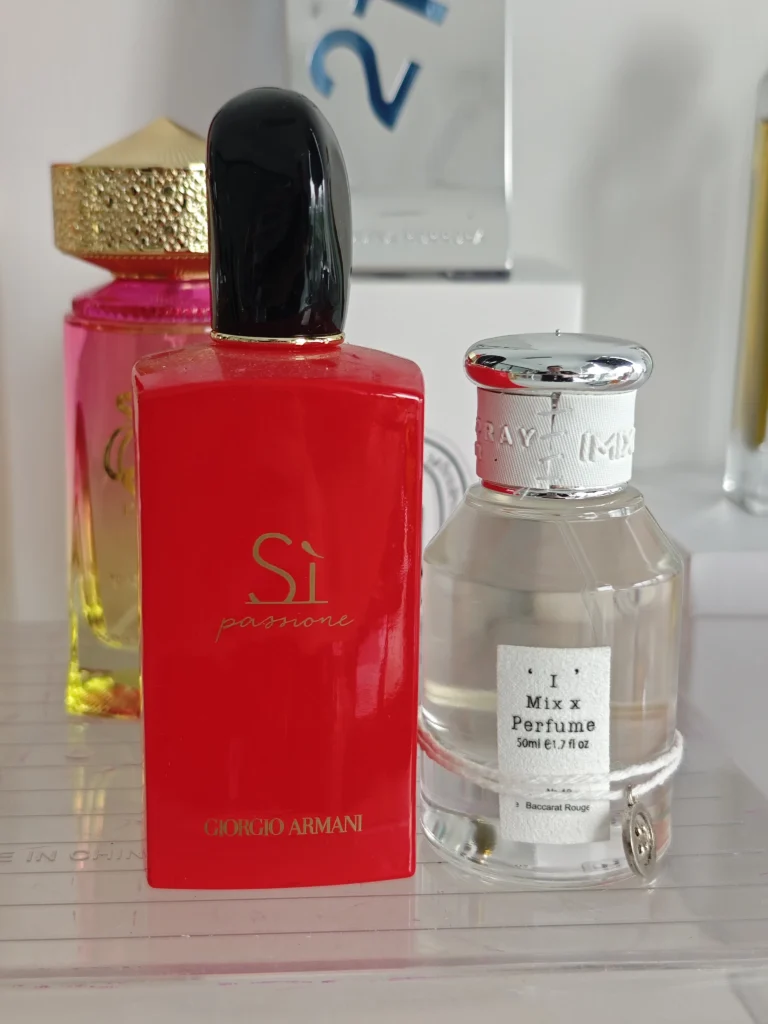
While they share a brand name, they are fundamentally different fragrances. The original Armani Sì (often in a nude/pink liquid) is a sophisticated, grounded chypre-fruity scent with a heavy woody/vanilla base. Si Passione (housed in the bright red bottle) is a much sharper, vibrant floral-fruity flanker. It introduces dominant notes of pear, pineapple, and spicy pink pepper. Passione is often described as more tropical and energetic but generally lacks the deep, long-lasting maturity of the original.
What does a woody freesia alternative smell like?
A “woody freesia alternative” is an industry shorthand often used to describe fragrances inspired by the Armani Sì profile. It smells like a beautiful juxtaposition of light and dark: it opens with the airy, luminous, slightly soapy floral scent of freesia petals, which is then quickly grounded by a rich, earthy, and warm base of blond woods and patchouli. It feels elegant, slightly sweet, and very professional.
Why do some dupe perfumes smell like rubbing alcohol?
This is due to a lack of maceration. High-quality perfumes are aged in vats for weeks to allow the fragrance oils and perfumer’s alcohol to bind seamlessly. Cheap, mass-produced perfumes are bottled and shipped immediately. If your new perfume smells like alcohol, spray it a few times to introduce oxygen, then store it in a dark drawer for a month to let it macerate at home. The smell will improve significantly.
Conclusion: Making an Empowered, Educated Choice
The fragrance you wear is a deeply personal extension of your identity. The aura of Armani Sì—confident, elegant, and uncompromising—is universally appealing. However, as we have explored through the lens of supply chain economics, olfactory chemistry, and blind panel data, achieving that sophisticated scent profile no longer requires spending $150 at a department store.
Finding the perfect Sì Eau De Parfum dupe in the US market means looking past the pretty packaging and asking the right questions. What is the concentration? Has the liquid been properly macerated? Does the brand invest in high-quality base notes like fractionated patchouli, or do they rely on cheap synthetics that fade by lunchtime?
Whether you choose the risk-free floral brightness of Dossier, the heavy projection of ALT, or the meticulously balanced, factory-direct longevity of IMIXX No. 49, you are now equipped with the industry knowledge to make a smart, informed decision. You do not have to sacrifice quality for price. By choosing transparency and demanding better manufacturing practices, you can wear luxury every single day.
