

Best Fragrance Lists, Blog, Designer Dupe Reviews
The Chemistry of Perfumes Dupe: A 2026 Industry Analysis of High-Fidelity Replication
Feb
📑 Technical Abstract: The State of Fragrance Engineering (2026)
- Market Context: Economic constraints have driven a 300% surge in searches for “dupe website” and “fragancias,” but quality variability is high.
- The Problem: Low-cost knock off perfumes often exhibit high volatility due to a lack of sesquiterpene fixatives, leading to rapid evaporation rates (< 1 hour).
- The Methodology: High-fidelity replication requires Gas Chromatography-Mass Spectrometry (GC/MS) to identify molecular weight and structure.
- The IMIXX Standard: Formulations are stabilized at Extrait de Parfum concentration (30%+ oil) using IFRA-compliant raw materials to match the vapor pressure profile of luxury benchmarks.
The Chemistry of Perfumes Dupe: A 2026 Industry Analysis of High-Fidelity Replication
In the fragrance industry, there is a fundamental equation: Scent = Chemistry + Time.
As we navigate the economic landscape of 2026, the consumer shift towards perfume dupes is undeniable. However, significant confusion remains regarding the distinction between a generic “smell-alike” and a molecularly accurate fragrance replica.
This report serves to bridge that gap. Written from the perspective of the IMIXX Formulation Team, we will move beyond marketing claims and analyze the specific chemical engineering, supply chain logistics, and regulatory standards that define high-quality perfumery in the United States.
1. The Economic Reality: The Cost of Reverse Engineering
A frequent consumer question is how a brand can claim to replicate a $400 scent for a fraction of the price, while others sell knock off fragrances for $10 that smell terrible. The answer lies in the Barrier to Entry.
Creating a professional inspired perfume is not a matter of guesswork; it is a data-driven process. The following cost breakdown illustrates the R&D investment required for a single SKU before manufacturing even begins.
Table 1: R&D Cost Comparison (Professional Lab vs. “Garage” Brand)
| Cost Driver | Professional Lab (IMIXX) | Low-Cost Competitor |
|---|---|---|
| Benchmark Acquisition | $300 – $600 (Authentic samples) | $0 (Relies on online notes) |
| GC/MS Analysis | $2,000+ per scent | $0 (Skipped) |
| Trial Batches | 20-50 Iterations | 1-2 Iterations |
| Raw Material Sourcing | Global Suppliers (Grasse/Swiss) | Generic “Type” Oils |
Analysis: A small “mom and pop” shop cannot absorb a $2,500 startup cost per fragrance. They are forced to buy pre-mixed industrial oils, resulting in the low-fidelity clone fragrances found on budget marketplaces.
2. The Technology: Gas Chromatography-Mass Spectrometry (GC/MS)
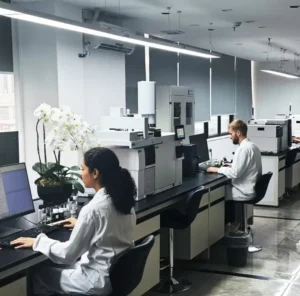
To accurately reconstruct a scent, we rely on Gas Chromatography-Mass Spectrometry. This is the industry standard for chemical analysis.
The Process Explained
- Separation (GC): The perfume is injected into the machine and heated. As it travels through a silica column, individual molecules separate based on their volatility and interaction with the column coating.
- Identification (MS): Each molecule enters the Mass Spectrometer, where it is bombarded with electrons. The molecule fragments into a unique pattern (mass spectrum), which acts as a fingerprint.
- Quantification: We compare these fingerprints against the NIST Mass Spectral Library to identify specific compounds like Hedione, Iso E Super, or Ambroxan.
Without this data, a brand is simply guessing. With it, IMIXX can achieve a structural match of 95% or higher to the target profile.
3. The Chemistry of Volatility: Why Cheap Dupes Fade
The most common failure point for perfume alternatives is longevity. In chemical terms, this is a function of Vapor Pressure.
The Molecular Pyramid
- High Vapor Pressure (Top Notes): Molecules like Limonene (Citrus) evaporate rapidly at room temperature. Cheap knock off fragrances are composed of 80-90% high vapor pressure molecules because they are inexpensive.
- Low Vapor Pressure (Base Notes): Molecules like Vanillin or large cyclic musk compounds evaporate very slowly. These act as “fixatives,” weighing down the lighter molecules.
The IMIXX Formulation Strategy: We purposefully overload the base formulation with low vapor pressure fixatives (such as Veramoss and Ambrofix). This physically traps the lighter scent molecules, reducing their evaporation rate and extending the wear time of the fragrance replica to 8+ hours.
4. Concentration Classes: Defining “Extrait”
Marketing terms often obscure the technical reality. The longevity of a fragrance clone is directly correlated to the ratio of aromatic oil to ethanol solvent.
Most commercial designer fragrances are formulated as Eau de Toilette (EDT), containing 10-15% oil. This is a cost-saving measure by large conglomerates.
At IMIXX, we formulate at Extrait de Parfum standards. This implies:
- Oil Concentration: 25% – 35% (varies by scent profile).
- Alcohol Content: Reduced to 65-75% (SDA-40B cosmetic grade).
- Impact: Higher viscosity and density, leading to better skin adhesion.
5. Case Studies: Chemical Challenges in Replication
To demonstrate the complexity of our work, we present the technical challenges associated with three of our most popular inspired perfume projects.
Case Study A: Replicating “Santal 33” (Le Labo Inspiration)
The Target Molecule: Santalol (from natural Sandalwood) + Undecavertol (Violet Leaf nuance).
The Failure Point: Many copy fragrances substitute expensive Sandalwood with cheap Javanol or Ebanol. When overdosed, these synthetics create a distinct “dill pickle” or vinegar accord.
The IMIXX Solution: We utilize a proprietary blend of Amyris Oil, Cedarwood Virginia, and a controlled dosage of Iso E Super to mimic the creamy, papyrus-dry texture without the sour off-note.
Case Study B: Replicating “Baccarat Rouge 540” (MFK Inspiration)
The Target Molecule: Ethyl Maltol (Sugar) + Ambroxan (Amber).
The Failure Point: Olfactory fatigue. The original formula uses such high levels of heavy molecules that the nose often stops smelling it (anosmia).
The IMIXX Solution: We balance the Ethyl Maltol with Hedione HC (High Cis), a molecule known to increase the diffusion and radiance of a scent, ensuring the perfume replica remains perceptible to others even if the wearer becomes nose-blind.
6. Regulatory Compliance: Safety & IFRA Standards
Trust is built on safety. The fragrance industry is self-regulated by the International Fragrance Association (IFRA). Compliance with the IFRA 51st Amendment is non-negotiable for professional brands.
The Risk of Gray Market Dupes:
Unregulated dupe/ site marketplaces often sell products containing:
- DEP (Diethyl Phthalate): A solvent often used to extend scent life cheaply, but linked to endocrine disruption.
- Lyral (HICC): A potent allergen banned in the EU/UK but sometimes found in older or non-compliant formulations.
The IMIXX Compliance Protocol:
We verify that every formulation strictly adheres to IFRA Category 4 limits (Hydroalcoholic products applied to unshaved skin). We do not use banned phthalates or restricted nitro-musks.
Frequently Asked Questions (Technical & Legal)
Is chemical analysis (reverse engineering) legal?
Yes. Under the US Functionality Doctrine, a scent is considered a functional attribute of a product and cannot be copyrighted. Intellectual Property protection applies to the Trademark (Brand Name, Logo) and Trade Dress (Bottle Design). IMIXX operates legally by reverse engineering the functional liquid and selling it under our own distinct branding.
Why is Maceration necessary for Extrait concentrations?
Maceration allows for the thermodynamic stabilization of the mixture. In high-concentration formulas (Extrait), the ratio of oil to alcohol is high, making it difficult for the solution to homogenize. We age our batches for 4-6 weeks to ensure the ethanol “bite” dissipates and the molecular bonds stabilize.
How does IMIXX verify the longevity of its perfumes?
We conduct standard Blotter Strip Tests and In-Vivo (Skin) Testing. Blotters are dipped and monitored at 1, 4, 8, and 24-hour intervals to track the evaporation curve. Skin testing confirms the interaction with natural pH and heat.
Where can I purchase verified high-fidelity replicas?
To ensure you are purchasing a product that has undergone GC/MS verification and safety testing, verify the source. IMIXX.net is our exclusive direct-to-consumer channel for the United States market.
Conclusion: The Scientific Path to Luxury
The era of “blind buying” based on marketing hype is ending. As the data shows, there is a quantifiable, chemical difference between a cheap knock off perfume and a professionally engineered fragrance replica.
At IMIXX, our commitment is not just to the scent, but to the science behind it. By investing in GC/MS technology, sourcing premium raw materials, and adhering to strict maceration protocols, we offer a product that stands up to scrutiny—both in the lab and on your skin.
We invite you to explore our collection, engineered for those who understand that true quality is molecular.
View the Technical Specifications & Shop »
Disclaimer: IMIXX competes with the designer brands mentioned in this report. IMIXX does not use their fragrances and is not associated in any way with the designer brands or their manufacturers. All trademarks are property of their respective owners. References to brand names are made strictly for comparative purposes under the principles of Fair Use and the FTC Statement of Policy Regarding Comparative Advertising.
